Cassius Clay (Muhammad Ali)
Three-time World Heavyweight Boxing Champion and Cultural Icon · Boxing - Professional
Professional Boxing / Nation of Islam
Era
Early Career - circa 1960-1964
Item Type
Paper Cut
Condition
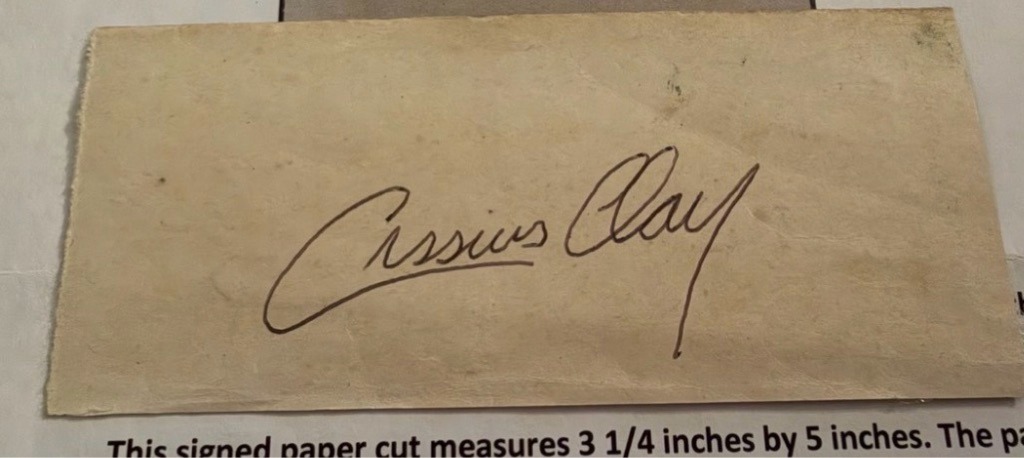
Good to Very Good. The autograph remains bold and legible. The paper shows age-related yellowing, minor creases, and rough edges on the left side where it was likely removed from a book.
Rarity
Very Rare. While Ali signed prolifically as 'Muhammad Ali' for decades, signature examples as 'Cassius Clay' are much harder to find and highly coveted.
Overall Assessment
This is a premium-tier sports collectible. The quality of the signature and the rarity of the name 'Cassius Clay' make it a highly desirable asset for serious memorabilia investors.
Authenticity Assessment
Likely authentic; confidence level: High. The signature displays the characteristic flow, letter formation, and 'y' tail drape consistent with Clay's handwriting before his name change in March 1964.
Signature Style
Cursive full name (Cassius Clay). Features the distinctive looped 'C's and the long, sharp descending tail on the 'y' in Clay which is a primary hallmark of his early signing style.
Signature Characteristics
Natural slant to the right. The 'ss' in Cassius is tightly grouped. The 'l' in Clay is looped and follows a strong, upward connecting stroke from the 'C'. Speed is high with no evidence of ink pooling or stops.
Ink & Medium
Early ballpoint pen with black ink. The ink shows natural aging and slight saturation into the paper fiber consistent with 60-year-old documents.
Item Description
A rectangular paper clipping/cut measuring 3 1/4 inches by 5 inches. The paper appears to be aged off-white or cream-colored scrap paper or from an autograph book page.
Estimated Value
$2,500 - $4,500 USD (Authenticated). Values for 'Cassius Clay' signatures are significantly higher than 'Muhammad Ali' signatures due to the limited four-year window of his professional career using this name.
Comparison to Known Examples
Highly consistent with known 1960 Olympic-era and early professional-era autographs. Matches the geometry of documented examples from his first bout with Sonny Liston.
Authentication Tips
Look for the fluid, rapid motion of the 'C' in Cassius. Forgeries often appear slow or shaky. The 'y' in Clay should have a long, sweeping tail that often hooks slightly or maintains a sharp taper without hesitation marks.
Certification Recommendation
PSA/DNA, JSA (James Spence Authentication), or Beckett Authentication Services (BAS). PSA/DNA is often preferred for premium 'Cuts' like this due to their extensive database of early 60s exemplars.
Red Flags
No significant red flags observed. The flow is natural and the aging of the paper and ink suggests a period-authentic piece rather than a modern recreation.
Provenance Notes
Ideally, this would be accompanied by the original autograph book it was removed from; however, the physical characteristics of the cut suggest it was a standard in-person request from the early 1960s.
Historical Context
Signed before his conversion to Islam and name change in 1964. This era represents his rise as 'The Louisville Lip' and his shocking victory over Sonny Liston to become champion.
Market Trends
Appreciating. Cassius Clay signatures have seen a steady 5-10% annual increase in value as high-grade early career material becomes increasingly scarce.
Investment Potential
Excellent. This is a blue-chip sports autograph. As one of the most famous men in history, his early name signatures are foundational pieces for any high-end sports collection.
Similar Autographs
Sonny Liston, Joe Frazier, or 1960 Olympic Team memorabilia. Collectors of 'The Greatest' often seek a 'Cassius Clay' and a 'Muhammad Ali' to bookend his career.
Display & Preservation
Should be framed with UV-protective glass and acid-free mats. A 'Float' mount would highlight the vintage cut edges. Keep away from direct sunlight to prevent ink fading.
Interesting Facts
After 1964, Ali famously refused to sign his 'slave name' (Cassius Clay), making these early signatures a vital record of his pre-political and pre-religious transformation.