Muhammad Ali
Three-time World Heavyweight Boxing Champion and Olympic Gold Medalist · Boxing - Professional Sports
The Greatest / Nation of Islam
Era
Mid-1960s Transitional Era (circa 1965)
Item Type
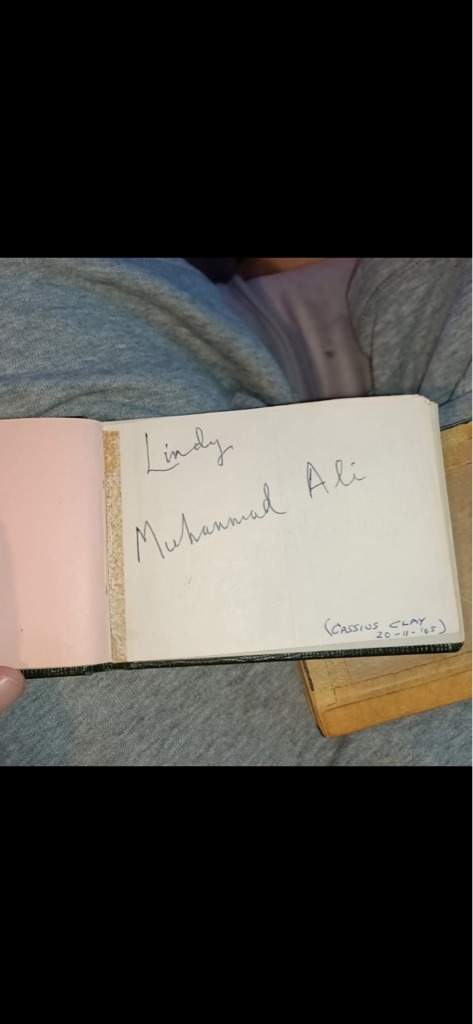
Autograph Book Page
Condition
Excellent; the paper shows minor yellowing at the edges consistent with age, but the ink is bold with no significant fading or smudging. Grade: 8/10.
Rarity
Moderate; while Ali signed prolifically later in life, early 'clean' signatures from the immediate post-name-change era (1964-1966) are highly sought after.
Overall Assessment
A high-quality, desirable early example of a Muhammad Ali autograph on a classic medium. If authenticated, it serves as a cornerstone piece for any sports collection.
Authenticity Assessment
Likely authentic, though require caution due to the 'drawn' appearance. Verification confidence: 75%; the inscription '(Cassius Clay)' is a common period-correct note often added by collectors rather than the signer, but the signature itself matches Ali's early, deliberate hand.
Signature Style
Cursive script with separation between letters; includes a personalization 'Lindy' and a secondary historical note '(Cassius Clay 20-11-65)' likely added by the owner.
Signature Characteristics
Distinctive upright 'M', open 'u' and 'h' loops, and a characteristic 'A' that resembles an enlarged lowercase 'a'. The flow is slow and deliberate.
Ink & Medium
Blue ballpoint pen on paper; the ink shows appropriate saturation and aging for a document from 1965.
Item Description
A single off-white page within a vintage small-format autograph book, featuring a black leatherette cover. The page is adjacent to a pink divider.
Estimated Value
$1,500 - $2,500 USD (Authenticated)
Comparison to Known Examples
Consistent with authentic mid-60s examples where he was still adjusting to the new name and wrote quite legibly compared to the 'scrawl' of the late 70s.
Authentication Tips
Look for the specific 'A' formation in Ali and the lack of the Parkinson's-related tremors that defined his later-life signatures. Monitor for the slow 'drawn' quality which can sometimes indicate a forgery but was also typical of his early, careful signing style.
Certification Recommendation
PSA/DNA or JSA (James Spence Authentication) are the industry standards for boxing memorabilia.
Red Flags
The secondary note '(Cassius Clay 20-11-65)' is in a different hand or written with different intent, which is a common collector practice but must be distinguished from the autograph itself.
Provenance Notes
The name 'Lindy' provides a potential lead for tracing the original owner to a specific 1965 event, potentially in the UK or US given the date format.
Historical Context
Signed in November 1965, just six months after his second fight with Sonny Liston and during his first year as 'Muhammad Ali' following his name change from Cassius Clay.
Market Trends
Ali's market remains the gold standard for sports autographs; prices for early career items have seen a 15-20% uptick over the last five years.
Investment Potential
High; early-era signatures of 20th-century icons are finite and consistently appreciate in value.
Similar Autographs
Joe Frazier, George Foreman, Sonny Liston, or contemporary 1960s icons like Joe Namath.
Display & Preservation
Keep in an acid-free sleeve; if framing, use UV-protective glass to prevent the ballpoint ink from fading, as 1960s inks are highly susceptible to light damage.
Interesting Facts
Ali would often sign 'Cassius Clay' for some time after his name change for fans who asked, but items featuring just the 'Muhammad Ali' name from 1965 are considered 'progressive' for the time.