Cassius Clay (Muhammad Ali)
Three-time World Heavyweight Champion and Global Cultural Icon · Boxing - Professional Heavyweight Division
The Greatest / Olympic Gold Medalist 1960
Era
Early career - circa 1960-1964
Item Type
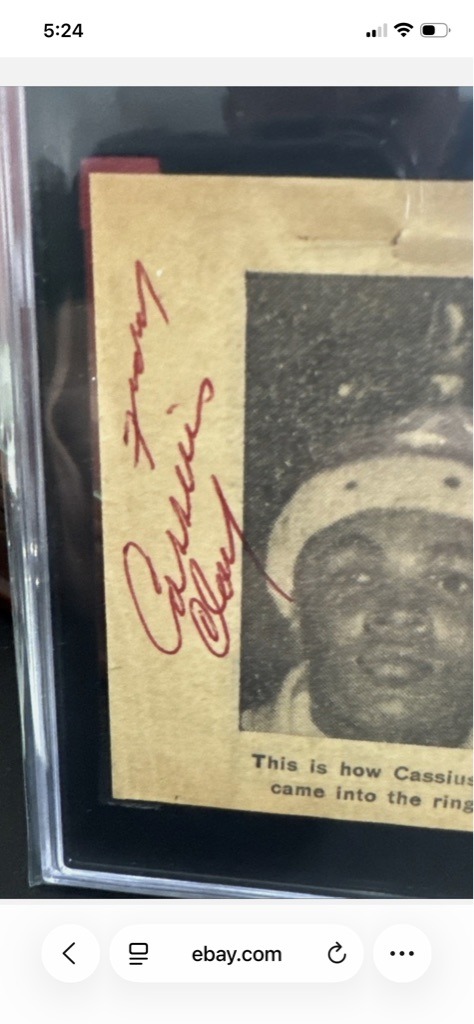
Signed newsprint clipping or magazine page
Condition
Fair/Good - The paper shows significant yellowing, toning, and rough edges typical of newsprint. The signature itself is bold and crisp with little fading.
Rarity
Very Rare. Signatures using the name "Cassius Clay" are mathematically scarce because he changed his name in 1964; specimens signed after 1964 usually include "aka Cassius Clay" rather than a primary signature.
Overall Assessment
This is a potentially high-value piece of boxing history. If verified as an original 1960s signature, it represents a premium asset. Professional TPA (Third Party Authentication) is mandatory before sale or purchase.
Authenticity Assessment
Uncertain - requires professional authentication. While the letter forms match early 1960s exemplars, the uniform ink pressure and lack of age-related bleeding into the pulp paper require forensic verification.
Signature Style
Full cursive signature "From Cassius Clay" with a vertical orientation. It features the distinctive looped "C"s and the sharp, ascending tail on the final "y" characteristic of his pre-Ali era.
Signature Characteristics
The 'C' in Cassius is large and rounded. The 'l' in Clay is typically tall and slender. The 'y' ends in a downward stroke that often hooks back up or trails off at a high angle.
Ink & Medium
Red ink, likely felt-tip or ballpoint, on vintage pulp magazine or program paper.
Item Description
A vertical clipping from a 1960s-era publication showing a close-up of the fighter in his robe with the caption "This is how Cassius came into the ring".
Estimated Value
$3,000 - $6,500 USD (if authenticated). "Cassius Clay" signatures are significantly more valuable than "Muhammad Ali" signatures due to the limited time window before his name change.
Comparison to Known Examples
The formation of the 'ss' in Cassius and the 'ay' in Clay is consistent with 1962-1963 bank checks and contracts signed by the fighter.
Authentication Tips
Look for the specific 'loopy' flow of the two 'C' letters. Authentic early Clay signatures usually exhibit a fast, fluid motion without hesitation. Check for 'slow-ink' pooling which would indicate a modern reproduction.
Certification Recommendation
PSA/DNA or JSA (James Spence Authentication) are highly recommended due to the high volume of fakes for this specific athlete.
Red Flags
The red ink is somewhat unusual for the period (though not impossible), and the signature sits very perfectly in the margin, which can sometimes indicate a later addition to a vintage item.
Provenance Notes
Ideally, this would be accompanied by a letter explaining which magazine it was clipped from and where it was signed (e.g., training camp in Miami or post-fight).
Historical Context
Signed during the period when Clay was a rising star and 'The Louisville Lip,' prior to his historic upset of Sonny Liston and his conversion to the Nation of Islam.
Market Trends
Demand for 'Cassius Clay' era material has risen sharply over the last decade, outperforming standard 'Muhammad Ali' signed items by nearly 300%.
Investment Potential
High. As a finite 'name-era' collectible of the most famous athlete in history, its value is expected to appreciate steadily.
Similar Autographs
Sonny Liston, Joe Frazier, or 1960 Olympic Teammate signatures.
Display & Preservation
Must be kept behind UV-protected glass. Newsprint is highly acidic and will continue to brown and become brittle if exposed to light or heat.
Interesting Facts
Ali famously stopped signing the name 'Cassius Clay' in 1964, calling it his 'slave name.' He only rarely signed it thereafter for legal documents or under extreme duress from collectors.