Cassius Clay (Muhammad Ali)
Undisputed Heavyweight Boxing Champion and 1960 Olympic Gold Medalist · Boxing - Sports
USA Olympic Boxing Team / World Heavyweight Champion
Era
Early Career - circa 1960-1964
Item Type
Cut Signature / Index Card
Condition
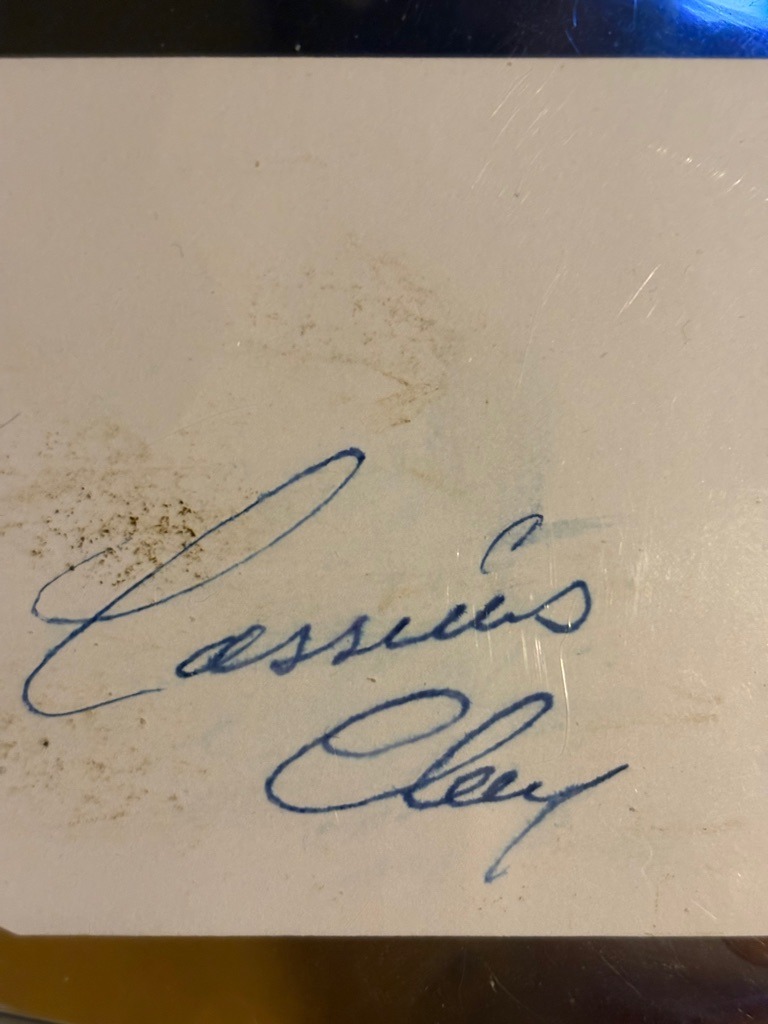
Good to Very Good. The ink is bold, but the paper shows significant handling wear, surface scuffs, and organic staining near the top.
Rarity
Highly Rare. Authentic 'Cassius Clay' signatures are far more scarce than 'Muhammad Ali' versions due to the short timeframe in which he used the name.
Overall Assessment
While the signature captures the general aesthetic of Clay's early hand, the lack of fluid motion and specific line-quality characteristics suggest it needs professional 'Letter of Authenticity' verification before any financial transaction is completed.
Authenticity Assessment
Questionable - several concerns noted regarding flow and formation. Requires professional physical inspection.
Signature Style
Full name cursive signature featuring the birth name 'Cassius Clay', which he famously stopped using in 1964.
Signature Characteristics
Features a loop-top 'C' in Cassius, a distinct 's' formation, and a slightly separate 'Clay'. The slant is traditionally uphill or neutral.
Ink & Medium
Blue ballpoint pen on plain white cardstock or paper scrap.
Item Description
A small, non-descript paper clipping or card containing a blue ballpoint ink signature; the paper shows surface scratching and minor staining.
Estimated Value
$1,500 - $3,500 (If authenticated); significantly lower if unverified or determined to be a replica.
Comparison to Known Examples
This example shows slightly more rigid letter formation than typical 1960-era examples, which usually exhibit more speed and 'roundness' in the cursive vowels.
Authentication Tips
Look for a continuous, fluid movement in the 'C' and 'l'. Check for natural ink bleeding consistent with 1960s ballpoint technology and look for 'shake' or hesitation marks which may indicate a tracing.
Certification Recommendation
PSA/DNA or JSA (James Spence Authentication). These are the industry leaders for high-value vintage sports signatures and carry the most weight for Ali/Clay items.
Red Flags
The 'l' and 'a' in Clay appear somewhat cramped, and the pen pressure seems unusually heavy and uniform, which can sometimes suggest a slow, deliberate forgery or tracing rather than a quick, natural signature.
Provenance Notes
Documentation is critical for Clay signatures. Letters from the original recipient or period photos of the signing session add massive value.
Historical Context
He adopted the name Muhammad Ali in March 1964 after joining the Nation of Islam. Autographs using his birth name represent his rise to the heavyweight title and his Olympic victory.
Market Trends
Cassius Clay signatures are consistently appreciating as they are the 'Holy Grail' for boxing collectors and civil rights historians. Demand remains extremely high.
Investment Potential
High. Pre-1964 signatures from this iconic figure have a restricted supply and a global collector base that spans sports, politics, and history.
Similar Autographs
Joe Frazier, Sonny Liston, or early 1960s Olympic team members from the Rome Games.
Display & Preservation
Should be kept in a UV-protected acrylic slab or framed with acid-free museum-grade matting to prevent further yellowing of the paper.
Interesting Facts
After changing his name, Ali famously called his birth name his 'slave name' and generally refused to sign cards or items as 'Cassius Clay' for decades, making those that do exist highly coveted.