Muhammad Ali (born Cassius Clay)
Three-time World Heavyweight Boxing Champion and Sports Icon · Boxing - Heavyweight Division
Olympic Gold Medalist (1960), WBA/WBC Champion
Era
Modern Era - circa late 1980s to 1990s
Item Type
Photograph
Condition
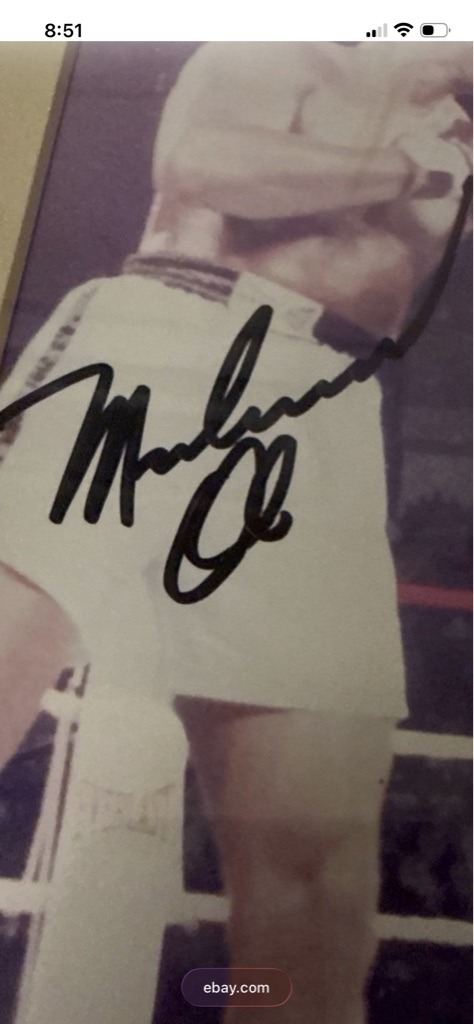
Good. The signature is bold and dark with no obvious fading, though the item shows some signs of cropping or mounting in the provided image.
Rarity
Common for the signer; Ali was one of the most prolific signers in history, though high-quality examples on iconic photos remain in high demand.
Overall Assessment
The autograph appears to be a common 1990s style Muhammad Ali signature. Because it is on a photo and is one of the most forged signatures in history, professional 3rd-party authentication is mandatory before it can be considered a high-value asset.
Authenticity Assessment
Questionable - requires professional authentication. While it captures the general letterforms of Ali's later signature, the thickness of the ink and some of the stroke junctions appear slow and non-fluid, which can be a sign of a tracing or a forgery.
Signature Style
Stylized later-life signature, typically featuring a large 'M' and looping 'A' followed by 'l' and 'i'.
Signature Characteristics
The 'M' has three distinct humps; the 'A' and 'l' in Ali are often connected in a flowing loop. This specific example has a very thick 'l' and 'i' which lacks the natural taper usually seen in his hand.
Ink & Medium
Black felt-tip permanent marker (Sharpie style) on a photographic print.
Item Description
Promotional or iconic action photograph of Muhammad Ali in the ring wearing Everlast trunks.
Estimated Value
$400 - $800 (If authenticated by PSA/DNA or JSA). Unauthenticated value is significantly lower, around $100-$150 due to the high volume of forgeries.
Comparison to Known Examples
The formation of the 'M' and the looping 'Ali' are consistent with his 1990s style, but the saturation of the ink is heavier than most authentic sport-signed examples.
Authentication Tips
Look for the 'shaky' hand indicative of Ali's Parkinson's in very late examples versus the fluid, quick strokes of his peak. Forgers often try to mimic the shake but do so with 'hesitation marks' that look jagged rather than natural tremors.
Certification Recommendation
PSA/DNA or JSA (James Spence Authentication). These are the industry leaders for Ali autographs.
Red Flags
The ink flow appears heavy and consistent throughout, suggesting a lack of varying pen pressure. The junction between the 'u' and 'h' in Muhammad appears slightly unnatural.
Provenance Notes
Look for a Certificate of Authenticity (COA) from a reputable source like Online Authentics (which Ali's team used specifically) or a major auction house.
Historical Context
Ali's signature transformed from the clear 'Cassius Clay' of the early 60s to the flowing 'Muhammad Ali' of the 70s, eventually becoming more labored in the 90s and 2000s.
Market Trends
Ali's market is stable but has softened slightly due to the massive volume of signed items he produced during his retirement years.
Investment Potential
Moderate. Authentic, high-grade Ali photos are a 'blue chip' of sports collecting but unlikely to see rapid appreciation due to high supply.
Similar Autographs
Mike Tyson, Joe Frazier, George Foreman.
Display & Preservation
Keep out of direct sunlight as felt-tip ink is highly prone to UV fading. Use UV-protective acrylic or glass.
Interesting Facts
Ali was known for never turning down a fan's request for an autograph until his health made it physically impossible to sign.