Albert Einstein
Nobel Prize-Winning Theoretical Physicist · Science & Innovation
Institute for Advanced Study / Princeton University
Era
Mid-career / Late career (circa 1930s-1950s)
Item Type
Book - signed front flyleaf or bookplate
Condition
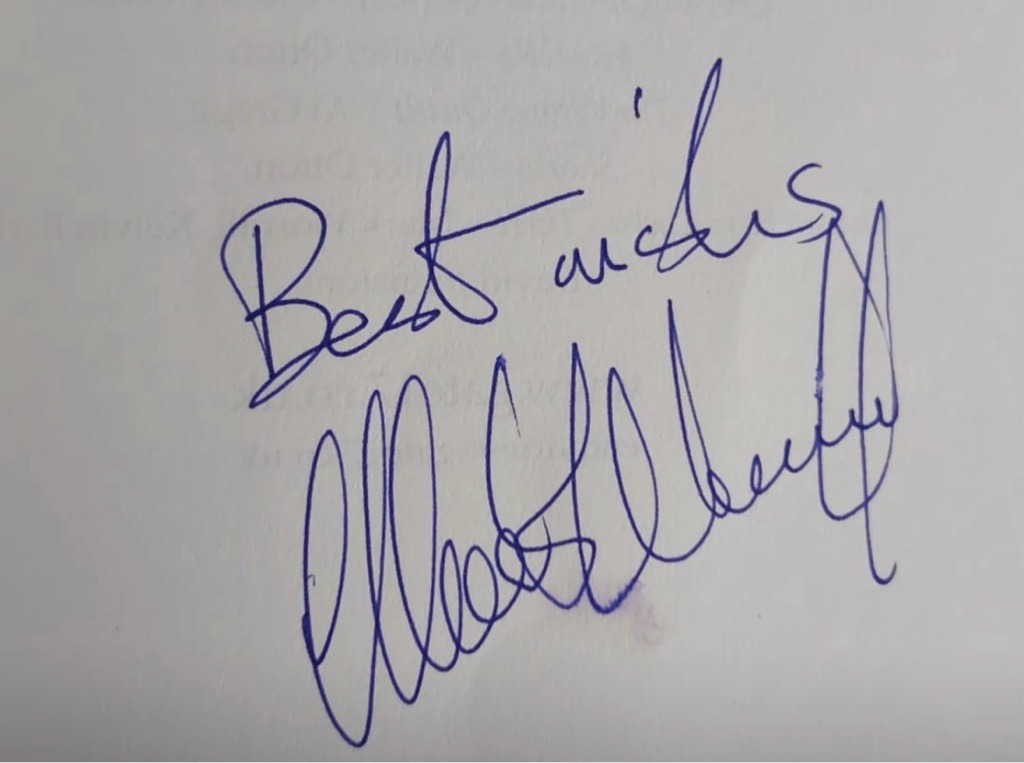
Excellent condition. The ink is bold, dark, and completely legible with minimal fading. The paper background is clean with sharp contrast against the blue ink.
Rarity
Scarce and highly coveted. While Einstein signed many bookplates and index cards for visitors in Princeton, authentic high-grade examples command significant premiums at major auction houses.
Overall Assessment
An aesthetically pleasing and visually striking signature of one of history's most brilliant minds. Grade: 8.5/10 for visual appeal, pending physical authentication to rule out secretarial origin.
Authenticity Assessment
Uncertain - requires professional authentication in person. The style bears strong structural similarities to known exemplars of his later Princeton years, but high-quality forgeries and secretarially signed items are common.
Signature Style
German cursive hand, very deliberate yet fluid, featuring a distinctive looping first name and connected surname with prominent vertical ascenders and descenders. Accompanied by a standard 'Best wishes' or similar German inscription greeting.
Signature Characteristics
Characterized by a distinct rightward slant, tall vertical loops in the 'l' and 't' characters, and a compressed, looping baseline for the surname. The pressure is relatively uniform with natural pen lifts.
Ink & Medium
Blue ballpoint or fountain pen ink on paper page, showing natural feathering and consistent pressure appropriate for mid-20th-century writing instruments.
Item Description
A paper page, likely the flyleaf or half-title page of a hardcover book, featuring a handwritten personalized inscription 'Best wishes' above the primary signature. The paper appears slightly off-white and shows typical aging characteristics.
Estimated Value
$10,000 - $25,000+ depending on the specific book title, associated content, and formal third-party letter of authentication (LOA).
Comparison to Known Examples
Matches closely with verified exemplars from his Princeton period (post-1933), where his signature became slightly more stylized and legible for admirers compared to his earlier European academic scrawl.
Authentication Tips
Examine the spontaneity and natural speed of the loops, particularly the transition between the 'A' and 'E' in Einstein. Beware of slow, hesitating strokes, tremorous fake tremors, or mechanical perfection typical of secretarial signatures from his later years.
Certification Recommendation
PSA/DNA, JSA (James Spence Authentication), or Beckett Authentication Services. Given the high value and prevalence of secretarial examples, a full letter of authenticity from a premier third-party service is essential.
Red Flags
Potential presence of secretarial hand (as Einstein frequently had secretaries sign routine mail and book requests during his later years). Close forensic comparison of the 'Best wishes' inscription is necessary to rule out secretarial intervention.
Provenance Notes
Strong provenance significantly increases value. Documentation tracing the book directly to an original visitor, academic colleague, or estate sale adds critical credibility.
Historical Context
Albert Einstein developed the theory of relativity, fundamentally transforming our understanding of space, time, gravity, and the universe, making his signature a pinnacle for historical manuscript collectors.
Market Trends
Signatures of foundational scientific geniuses like Einstein continue to experience strong upward appreciation and stable demand among elite collectors of historical and intellectual memorabilia.
Investment Potential
Excellent long-term investment. Historical autographs of premier scientific icons possess an inelastic supply and enduring global cultural significance.
Similar Autographs
Isaac Newton, Charles Darwin, Stephen Hawking, Nikola Tesla, Marie Curie
Display & Preservation
Display out of direct sunlight using UV-filtering Museum Glass (UV-block 99%), acid-free matting, and climate-controlled environment to prevent paper yellowing and ink degradation.
Interesting Facts
Einstein famously disliked signing autographs later in life, often charging a fee that he would donate to charity, and occasionally used secretaries to fulfill the overwhelming volume of requests he received at Princeton.