J. Whipple (John Whipple)
Wildlife Artist and Master Carver for Abercrombie & Fitch · Sporting Art and Wildlife Decoy Sculpture
Abercrombie & Fitch Co. (Custom Sporting Goods Era)
Era
Mid-Century - circa 1950s-1960s
Item Type
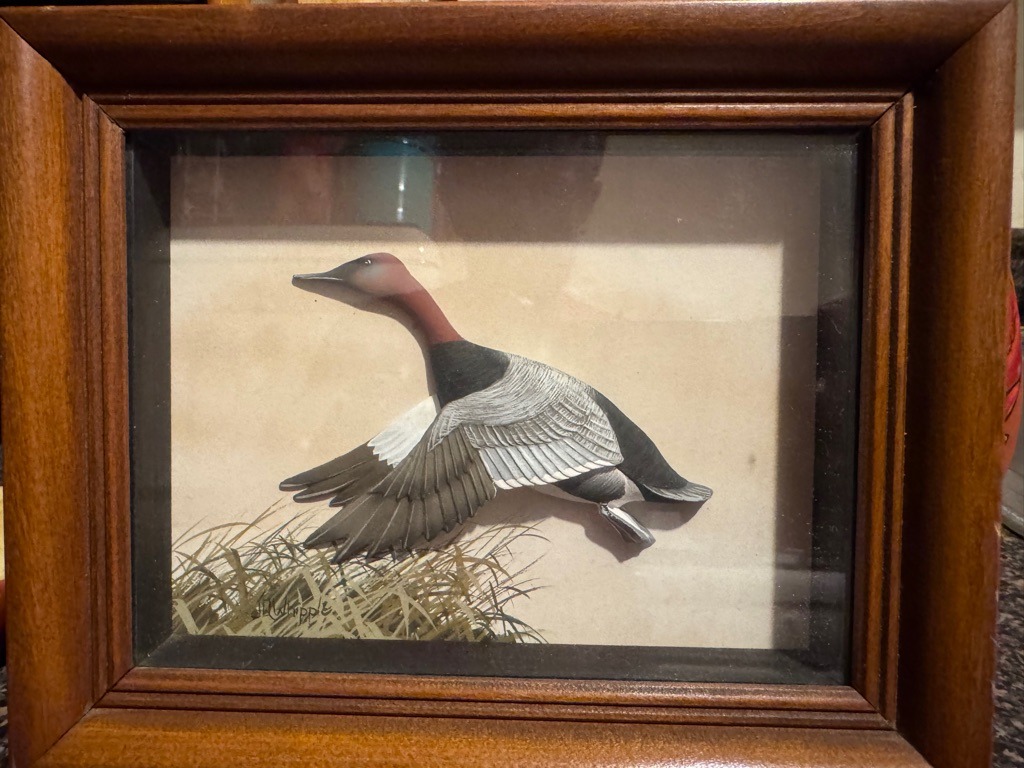
Hand-carved 3D Shadowbox Art
Condition
Excellent to Very Good. The carving detail (feathering) appears crisp. The background shows some slight age-toning (yellowing) common in mid-century paper materials. Frame shows minor wood shelf wear.
Rarity
Moderate. While Whipple produced many pieces for Abercrombie & Fitch, large-scale, high-detail examples in original frames are becoming increasingly scarce on the secondary market.
Overall Assessment
This is a quintessential example of J. Whipple's work for Abercrombie & Fitch. It possesses high aesthetic value and represents a specific niche of mid-century American sporting luxury. It is a highly desirable piece for a collector of waterfowl art.
Authenticity Assessment
Highly likely authentic. The signature is integrated into the artwork, consistent with Whipple's known hand-painted shadowbox carvings sold through high-end retailers like Abercrombie & Fitch.
Signature Style
Stylized script, cursive lowercase with a prominent 'W'. The 'e' at the end is often slightly flourished downward. It is typically found in the lower left corner within the painted grass elements.
Signature Characteristics
Continuous flow, artist-quality brush control, no hesitation marks, signature is typically small and scaled to the size of the depicted reeds.
Ink & Medium
Oil-based or acrylic artist paint applied with a fine-tipped brush directly onto the background board.
Item Description
A 'large size' relief wood carving of a Canvasback duck in flight, mounted in a shadowbox frame with a hand-painted watercolor or gouache background depicting marsh grasses. Often sold as part of the 'Whipple Series' of waterfowl for luxury sporting retailers.
Estimated Value
$400 - $750 USD
Comparison to Known Examples
Matches verified Whipple carvings found in Abercrombie & Fitch vintage catalogs and Christie's/Sotheby's sporting art sales.
Authentication Tips
Look for the specific 'W' loop construction and the way the signature is 'hidden' in the marsh grass. Ensure the carving is actual wood and not a resin cast, which would indicate a later reproduction.
Certification Recommendation
Specialist Decorative Arts Appraisers (e.g., Guyette & Deeter for decoys/sporting art) rather than sports authenticators.
Red Flags
No significant red flags observed. The natural aging of the wood and the specific carving technique are consistent with period originals.
Provenance Notes
Look for Abercrombie & Fitch stickers or stamps on the rear backing paper of the frame, which significantly increases collector interest.
Historical Context
Created during the 'Golden Age' of Abercrombie & Fitch, when the company was a luxury outfitter for hunters and explorers like Hemingway and Roosevelt.
Market Trends
Stable to slightly appreciating. Mid-Century 'Man Cave' and luxury sporting decor have seen a resurgence in the Americana market.
Investment Potential
Good long-term hold. These are considered cross-collectible between wildlife art enthusiasts and vintage retail historians.
Similar Autographs
Milton Weiler (Watercolors), William J. Schaldach, and Frank Benson.
Display & Preservation
Keep out of direct sunlight to prevent the red pigment on the duck's head from fading. Ensure the seal on the back of the frame is intact to prevent dust entry into the shadowbox.
Interesting Facts
Whipple's carvings were the pinnacle of office and lodge decor in the 50s; they were often commissioned for CEOs of major American corporations through the A&F flagship store in New York.
Notes
Whipple large size Abercrombie