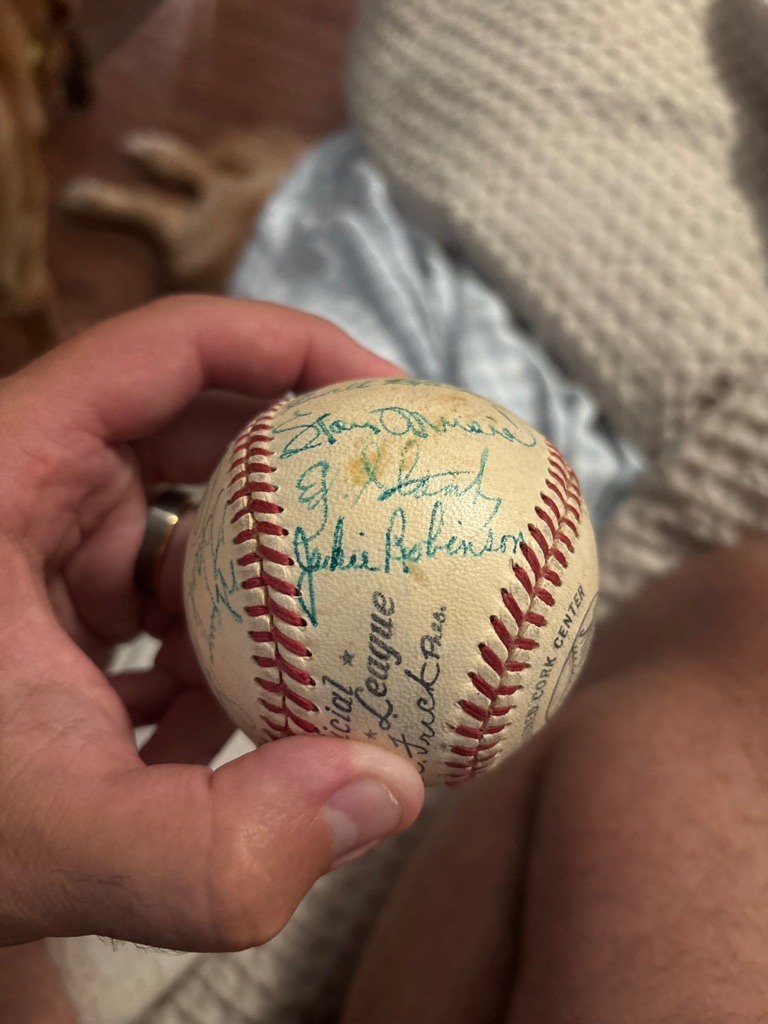
Jackie Robinson, Stan Musial, and Enos Slaughter
National Baseball Hall of Fame Legends · Baseball - MLB
Brooklyn Dodgers (Robinson), St. Louis Cardinals (Musial/Slaughter)
Era
Circa 1951-1953 (Ford Frick NL President Era)
Item Type
Team or All-Star Souvenir Baseball
Condition
Good to Very Good. The ball shows consistent yellowing, some surface scuffs, and minor spotting, but the 'signatures' are very clear and dark.
Rarity
Common. These souvenir stamped balls were sold in stadiums during the 1950s and are frequently found in the hobby today.
Overall Assessment
This is a classic 1950s souvenir stamped baseball. While it is a genuine vintage item from the era, the signatures are not hand-signed. It is a wonderful piece of baseball history but lacks the high value of a certified Jackie Robinson autograph.
Authenticity Assessment
Questionable - likely a stamped or souvenir ball. The consistency and color of the ink across all signatures suggest a mass-produced reproduction rather than hand-signed ink.
Signature Style
Uniform, scripted signatures characteristic of 1950s All-Star souvenir balls. They lack the natural variation of hand-signed autos.
Signature Characteristics
The signatures are placed too perfectly and share the exact same ink density and color, which is a hallmark of factory-stamped souvenir balls.
Ink & Medium
Teal/blue-green uniform ink on a leather Official National League baseball. The monochromatic and flat nature of the ink suggests a rubber stamp technology.
Item Description
An Official National League (Ford Frick, Pres.) baseball featuring multiple signatures from NL stars of the early 1950s.
Estimated Value
$50 - $150 as a vintage souvenir. If authentic hand-signed, the value would exceed $10,000, but this item appears to be a printed commemorative ball.
Comparison to Known Examples
These matches the exactly layout and font of the 1950s-era stadium souvenir balls sold at Ebbets Field or Sportsman's Park.
Authentication Tips
Look for 'bridging' where the ink meets the leather pores. A stamp sits on top uniformly; hand-signing shows variation in pressure and ink flow. Compare this to known 'stamped' balls from the 1950s.
Certification Recommendation
PSA/DNA or JSA. A 'QuickOpinion' service would likely identify this as a non-hand-signed item quickly.
Red Flags
The uniform blue-green ink color for every player, the lack of pen pressure/indentation, and the 'too good to be true' lineup of legends on a single panel.
Provenance Notes
Often passed down as 'Grandpa's signed ball' from a game, but usually purchased at a concession stand rather than signed in person.
Historical Context
The ball dates to the Ford Frick presidency (1934-1951) or his early years as Commissioner when his name remained on NL balls. It represents the height of the Golden Age of Baseball.
Market Trends
Prices for authentic Jackie Robinson items are soaring, but the market is flooded with these specific 1950s stamped souvenir balls.
Investment Potential
Low. As a mass-produced souvenir, it maintains value as a vintage collectible but does not appreciate like a hand-signed artifact.
Similar Autographs
1950s Dodgers or Cardinals team-signed baseballs.
Display & Preservation
Keep in a UV-protected cube. Even as a souvenir, the leather will continue to tan if exposed to sunlight.
Interesting Facts
During this era, souvenir balls were produced with high-quality stamps that have fooled many families for generations into thinking they owned a hand-signed treasure.