None / Not Identifiable as an Autograph
Ancient Potter or Merchant (Speculative) · Archaeology / Ceramic Antiquities
Classical or Byzantine Era Pottery Workshop
Era
Likely Roman to Byzantine period (c. 1st Century BC – 7th Century AD)
Item Type
Ancient Amphora / Ceramic Vessel
Condition
Fair to Good for a shipwreck find. The vessel appears structurally intact with heavy surface oxidation and calcification. Signature grade is N/A.
Rarity
Common for shipwreck sites in the Mediterranean, but unique as an individual handmade object.
Overall Assessment
This is a genuine ancient ceramic vessel, not a signed piece of memorabilia. Its value lies in its archaeological nature. Rating: 0/10 for autograph collectors, 7/10 for maritime history enthusiasts.
Authenticity Assessment
Highly likely authentic to the period as an archaeological artifact; however, there is no recognizable autograph or celebrity signature present.
Signature Style
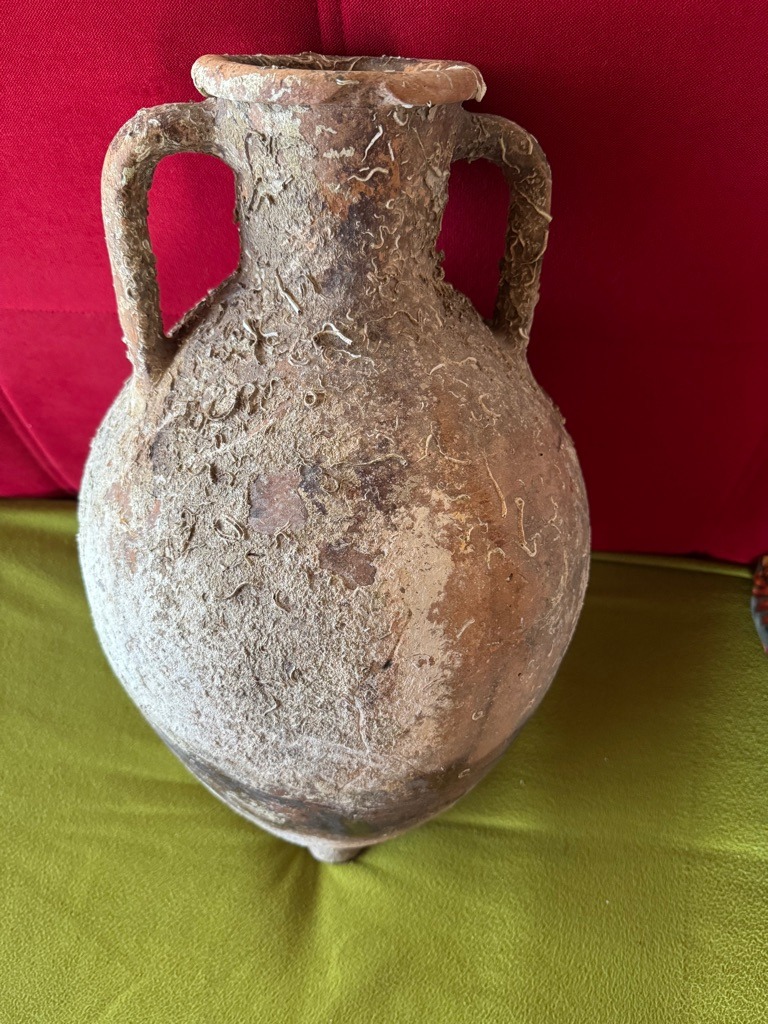
N/A. There are no recognizable alphabetical signatures. The surface contains marine encrustations (serpulid worm tubes) that resemble script but are natural biological growth.
Signature Characteristics
The 'marks' are curved, white, hollow tubes characteristic of Serpulidae. They lack the intentionality, repetitive pressure, or glyph-based structure of human writing.
Ink & Medium
None. The markings are three-dimensional calcium carbonate deposits from marine life, not ink or paint.
Item Description
A terracotta amphora, likely for transporting wine or oil, featuring two handles and a tapered base. The surface is covered in heavy marine concretion, including shell fragments and calcified worm tubes, indicating it was submerged underwater for a significant period.
Estimated Value
$400 - $1,200 USD (Valued as an antiquity, not as an autographed item; price depends heavily on provenance and export legality).
Comparison to Known Examples
When compared to actual potters' marks or scribal graffiti from the era, these markings lack the sharp incised lines or uniform ink strokes typical of the period.
Authentication Tips
Do not mistake marine life growth for writing. Authenticity for antiquities involves thermoluminescence (TL) testing and provenance research rather than handwriting analysis.
Certification Recommendation
Archaeological appraisal service or a specialist in ancient Mediterranean ceramics.
Red Flags
The primary red flag is pareidolia—the tendency to see writing or signatures in natural patterns. There is no evidence of a modern or ancient intentional signature here.
Provenance Notes
Essential to document how and where this was acquired. Items recovered from the sea are subject to strict international heritage laws (e.g., UNESCO 2001 Convention).
Historical Context
Amphorae were the 'shipping containers' of the ancient world. Their design allowed for efficient stacking in the holds of merchant ships across the Mediterranean and Black Seas.
Market Trends
The market for unprovenanced antiquities is shrinking due to tighter regulations. Significant value is placed on legally legally exported items with documentation.
Investment Potential
Low as a 'signature' piece, moderate as a decorative antiquity. Values for these items have remained relatively stable but face liquidity issues due to legal restrictions.
Similar Autographs
N/A. Collectors of this item would likely be interested in other shipwreck artifacts like Roman coins or lead anchors.
Display & Preservation
Keep in a stable environment with low humidity. Do not attempt to scrub off the white calcification, as it provides evidence of its underwater history and can damage the ceramic if removed aggressively.
Interesting Facts
Marine life, particularly serpulid worms, often creates patterns that collectors mistake for 'ancient code' or 'lost signatures' due to their resemblance to cursive script.