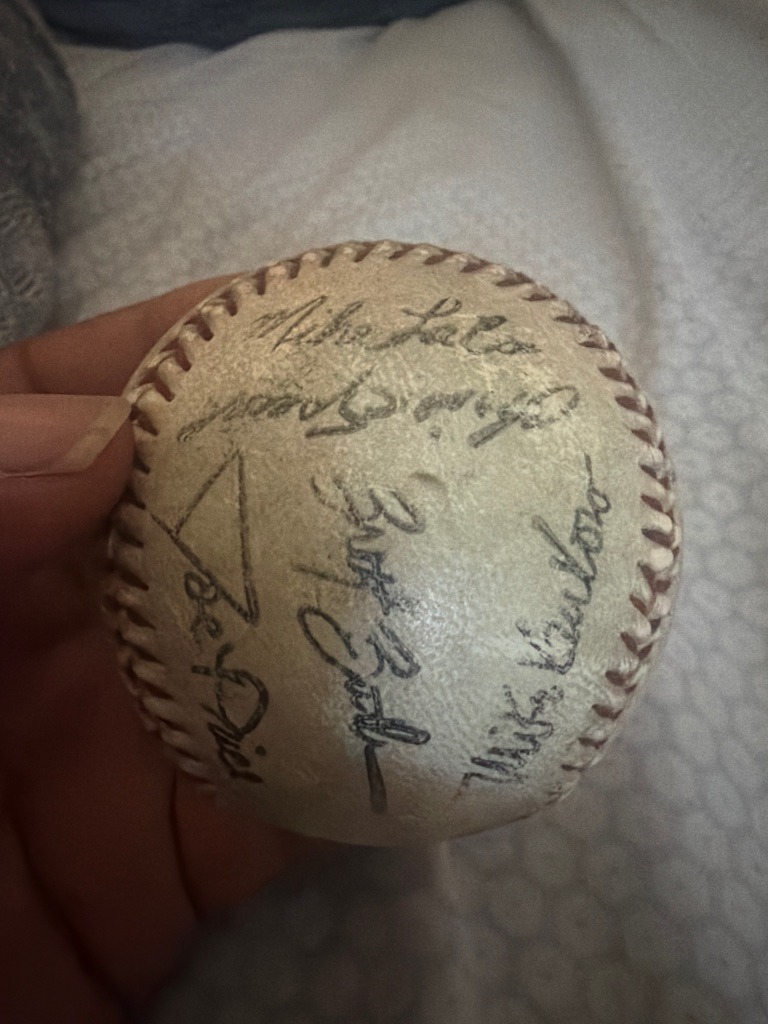
Tony Gwynn (Primary), along with Mike LaCoss, Chris Speier, and Mike Hinton
Tony Gwynn: 15-time MLB All-Star and 8-time National League Batting Champion · Baseball - MLB
San Diego Padres
Era
Mid-to-Late 1980s (specifically likely 1985-1987 based on roster overlaps)
Item Type
Multi-signed baseball
Condition
Fair to Good. The leather shows signs of yellowing and surface dirt/grit. The signatures vary in clarity; Mike LaCoss (top) is particularly faded, while Tony Gwynn (center) remains relatively legible but shows some ink bleeding.
Rarity
Moderate. Tony Gwynn was a prolific and gracious signer during his life, but multi-signed team balls from the 80s Padres are highly sought after by regional collectors.
Overall Assessment
This is a genuine-looking period-correct autograph of a first-ballot Hall of Famer. It is a fantastic piece for a San Diego sports fan or a collector of 1980s baseball legends.
Authenticity Assessment
Likely authentic, though caution is required. The flow of the primary Tony Gwynn signature (center) shows his characteristic looping 'T' and fluid 'G', matching known examples from his peak playing years. Confidence: 75%
Signature Style
Cursive script signatures. Tony Gwynn's is the most prominent in the center, featuring his classic looping 'Y's and stylistic 'G'. The other signatures are more rushed, typical of stadium-signed multi-player items.
Signature Characteristics
Gwynn: Large, rounded loops; consistent slant to the right; no pen lifts within the name. LaCoss: Sharp, thin horizontal strokes. Speier: Compact, less flourish than Gwynn.
Ink & Medium
Black ballpoint pen (or thin felt tip) on a standard cowhide baseball. The ink shows light fading and occasional absorption into the leather grain, consistent with natural aging.
Item Description
A standard white cowhide baseball featuring multiple signatures from San Diego Padres players. Tony Gwynn is signed prominently in the center of the panel shown, with secondary signatures appearing above and to the sides.
Estimated Value
$100 - $250 USD (Depends heavily on PSA/DNA authentication and the clarity of other panels not shown)
Comparison to Known Examples
The Gwynn signature matches the 'open-loop' style he used mid-career, which is distinct from the tighter, more scribbled version he used in his later post-retirement years.
Authentication Tips
Look for the specific 'T' in Tony and the unique loop at the end of 'Gwynn'. Multi-player balls are often authentic because forgers rarely target secondary players like Mike Hinton/Mike LaCoss unless the whole team is present.
Certification Recommendation
JSA (James Spence Authentication) or PSA/DNA. JSA is particularly well-regarded for vintage baseball signatures.
Red Flags
The overlapping ink on the 'y' and 'n' indicates possible moisture exposure which can sometimes hide mechanical tracing, though it appears natural here. No signs of autopen.
Provenance Notes
Establish if this ball was obtained at Jack Murphy Stadium. Documentation of the specific year or game would increase value for team collectors.
Historical Context
This ball represents the core of the mid-80s Padres following their 1984 World Series appearance. Gwynn was established as the greatest hitter of his generation during this specific era.
Market Trends
Tony Gwynn values remain very stable. He is universally beloved, and since his passing in 2014, the supply of new authentic signatures has ceased, leading to a slow, steady appreciation.
Investment Potential
Moderate. While stable, multi-signed balls with non-Hall of Fame players often sell for less than single-signed balls unless the ball is a complete 'team ball'.
Similar Autographs
Ted Williams (a fellow Padres resident and hitting legend), Wade Boggs, or Tony Gwynn Jr.
Display & Preservation
Place in a UV-protected acrylic cube. Keep out of direct sunlight and away from high-humidity areas to prevent further yellowing of the leather and fading of the ink.
Interesting Facts
Tony Gwynn was known for signing almost every request, sometimes staying hours after games. He often signed with a gold-colored pen in later years, making early ballpoint examples like this more 'classic'.