Muhammad Ali (born Cassius Clay)
Three-time World Heavyweight Boxing Champion and Olympic Gold Medalist · Sports - Boxing
Professional Boxing / Nation of Islam / United States 1960 Olympic Team
Era
Late Career/Post-Retirement - circa 1990s through early 2000s
Item Type
Book or Magazine Program
Condition
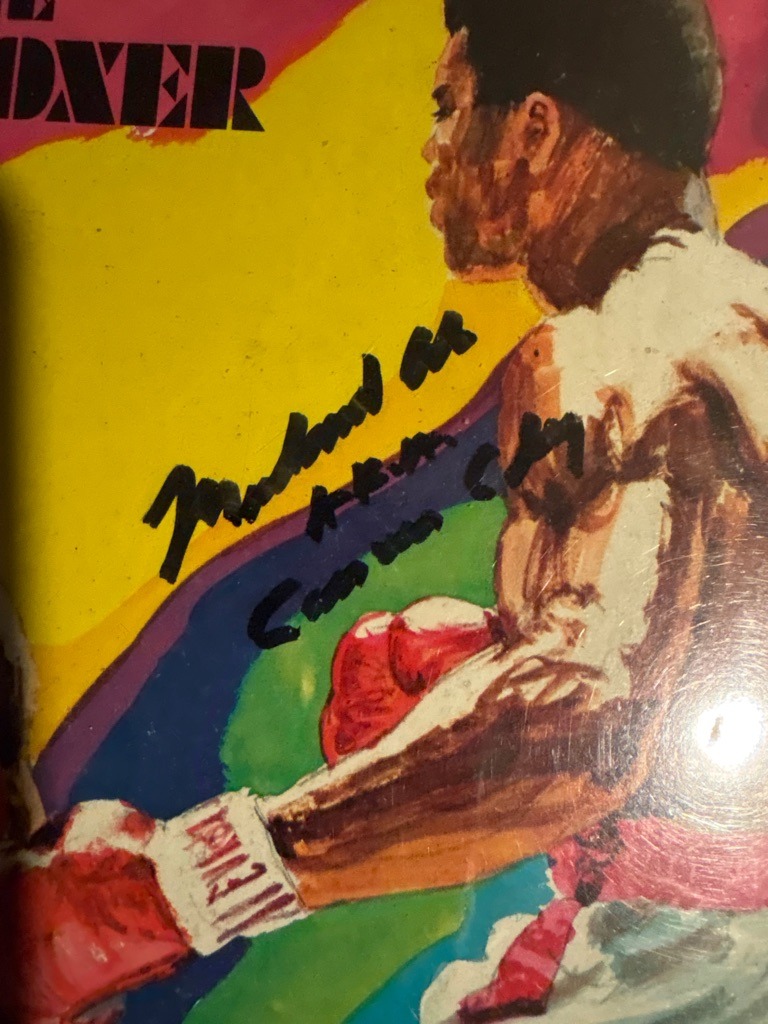
Excellent to Near Mint. The signature is bold and dark with no visible fading. The item surface shows minor shelf wear but the ink has adhered well to the glossy substrate.
Rarity
Moderate. Ali was a prolific signer throughout the 80s and 90s, but his signature became increasingly rare and difficult to produce as his health declined in the 2000s.
Overall Assessment
This is a classic late-career Muhammad Ali signature on a high-quality visual medium. Its authenticity characteristics are strong, exhibiting the genuine physical struggle and persistence for which his later years were known.
Authenticity Assessment
Likely authentic based on known physiological handwriting changes. High confidence, but requires full authentication due to the prevalence of Ali forgeries.
Signature Style
Three-line signature including 'Muhammad Ali' and 'Cassius Clay'. The style is shaky and labored, consistent with the signer's later-life Parkinson's-related tremors.
Signature Characteristics
Spiky letter forms with significant tremor throughout. The 'M' in Muhammad has a distinct sharp peak. The 'Cassius Clay' below is written in a slightly smaller, more compressed hand.
Ink & Medium
Black felt-tip permanent marker (Sharpie style) on a glossy book jacket or printed program.
Item Description
The item appears to be 'The Boxer' by Muhammad Ali (or similar promotional artwork). It features a stylized, colorful painting of Ali wearing Everlast gloves and red trunks.
Estimated Value
$400 - $800 USD (authenticated price range). Values for late-career Ali signatures are slightly lower than crisp 1970s examples but remain high due to global demand.
Comparison to Known Examples
Consistent with authenticated examples from the early 1990s. The 'C' in Clay and the 'A' in Ali follow his standard structural template despite the shaky execution.
Authentication Tips
Look for the specific 'Ali' loops and the unique way he transitioned into the 'Cassius Clay' secondary signature. Real tremors are erratic; forgeries often look too rhythmic or 'drawn'.
Certification Recommendation
PSA/DNA or JSA (James Spence Authentication). These are the industry leaders for Ali autographs and will significantly increase resale value.
Red Flags
No significant red flags observed. The ink flow and stop-start pressure points are consistent with natural hand tremors rather than a slow guided imitation.
Provenance Notes
Ideally, documentation of a signing event (like those organized by Steiner Sports) or a letter of provenance detailing when the book was signed would enhance the history.
Historical Context
Signatures featuring both 'Muhammad Ali' and 'Cassius Clay' are highly desirable as they represent the full scope of his personal and political identity.
Market Trends
Ali's signature remains one of the safest blue-chip investments in sports memorabilia, seeing steady appreciation since his passing in 2016.
Investment Potential
Excellent. As the 'Greatest of All Time,' demand for Ali autographs will always outpace the available supply of authentic examples.
Similar Autographs
Joe Frazier, George Foreman, Mike Tyson, or Sugar Ray Leonard signatures.
Display & Preservation
Keep away from direct UV sunlight as felt-tip ink is prone to fading. Use acid-free sleeves or UV-protective glass if framing.
Interesting Facts
Due to his Parkinson's, Ali sometimes used a rubber stamp for generic mail, making hand-signed ink examples like this essential for collectors.