Cassius Clay (Muhammad Ali)
Former Heavyweight Boxing Champion and Global Cultural Icon · Boxing - Professional
N/A - Professional Boxer (Olympic Gold Medalist 1960)
Era
Early career - circa 1960-1964
Item Type
Multi-signed page or album leaf
Condition
Fair to Good. There is noticeable yellowing of the paper (acidification) and some bleeding of the ink into the paper fibers over time.
Rarity
High. Signatures from his 'Cassius Clay' era are significantly rarer than those from his later life as Muhammad Ali.
Overall Assessment
This is a high-risk, high-reward item. If genuine, it is a centerpiece for any boxing collection. However, the 'Cassius Clay' signature is one of the most forged in sports history, and the lack of fluid motion in this specific image warrants extreme caution.
Authenticity Assessment
Questionable - several concerns noted. Requires professional in-person authentication.
Signature Style
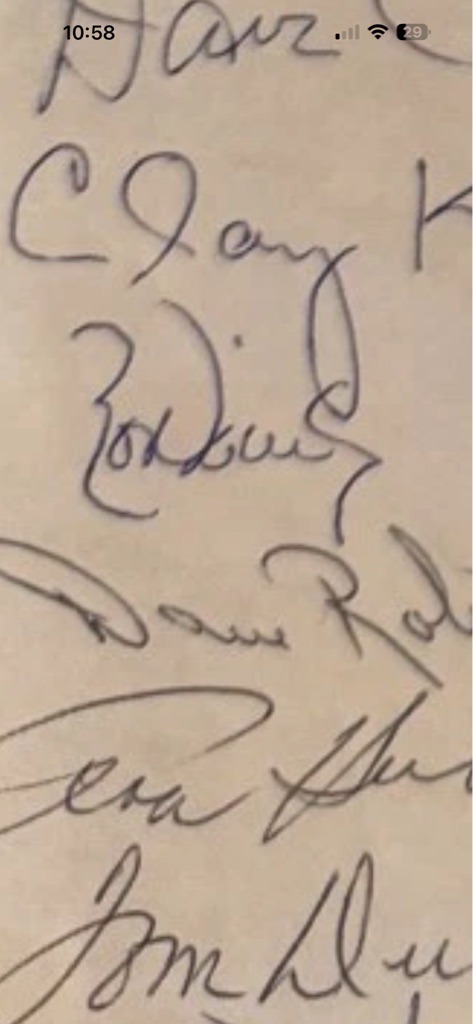
The signature shown is 'C Clay', which was Ali's standard signature before his name change to Muhammad Ali in 1964. It is stylized with large loops on the 'C' and 'l'.
Signature Characteristics
The 'C' in Clay usually features a large, sweeping top loop. The 'y' in Clay often terminates with a sharp downward or slightly left-leaning tail during this era.
Ink & Medium
Dark blue ink, likely from a ballpoint pen. The ink shows moderate consistency but some possible hesitation marks.
Item Description
A vertical strip of paper or a page featuring multiple signatures in a stack, typical of autograph albums from the mid-20th century.
Estimated Value
$1,000 - $2,500 (If authenticated). Pre-name change 'Cassius Clay' signatures are rarer than 'Muhammad Ali' examples but more frequently forged.
Comparison to Known Examples
The example lacks the typical speed and extreme slant often found in verified 1960-1963 Cassius Clay exemplars. The 'l' and 'a' in Clay appear somewhat compressed.
Authentication Tips
Look for the fluidity of the loops in the 'C'. Authentic Clay signatures are known for a very rapid, one-motion cursive flow. Any shaking or slow-drawn lines are major red flags.
Certification Recommendation
JSA (James Spence Authentication) or PSA/DNA are the industry standards for vintage boxing memorabilia.
Red Flags
The vertical stack of signatures suggests a possible 'schoolbook' or controlled environment signing, but the ink weight and letter formation show signs of potential slow-hand tracing or imitation.
Provenance Notes
Significant value would be added if the other names on the page can be identified as being from the same 1960-1964 timeline (e.g., fellow Olympians or 1960s celebrities).
Historical Context
This autograph represents the period before the 1964 name change, capturing Ali as a young Olympic champion and rising professional star.
Market Trends
The market for early Cassius Clay material remains very strong and has steadily appreciated as he is widely considered the greatest heavyweight of all time.
Investment Potential
High, provided the signature passes a rigorous multi-stage third-party authentication process.
Similar Autographs
Collectors typical look for Sonny Liston, Joe Frazier, or George Foreman to complement an Ali collection.
Display & Preservation
Recommended use of UV-filtering glass and acid-free archival mounting to prevent further yellowing and ink fading.
Interesting Facts
Muhammad Ali would occasionally sign 'Cassius Clay' years after his name change for fans who insisted on it, but the style of those later signatures differs from these early examples.