Muhammad Ali (born Cassius Clay)
Three-time World Heavyweight Boxing Champion and cultural icon · Boxing - Heavyweight Division
Olympic Gold Medalist (1960), WBA/WBC Champion
Era
Late Career/Post-Retirement - circa 1980s to early 1990s
Item Type
Color photograph
Condition
Excellent; signature is bold and dark with no visible fading; the photo shows crisp colors and minimal surface wear.
Rarity
Common for the era; Ali was a prolific signer regardless of his health, though 'aka Cassius Clay' inscriptions add more value.
Overall Assessment
A classic example of a late-period Ali signature featuring the desirable 'aka Cassius Clay' inscription. This is a staple piece for high-end sports collectors.
Authenticity Assessment
Likely authentic, though requires physical inspection due to the shaky nature of his later signatures. Confidence: 85%
Signature Style
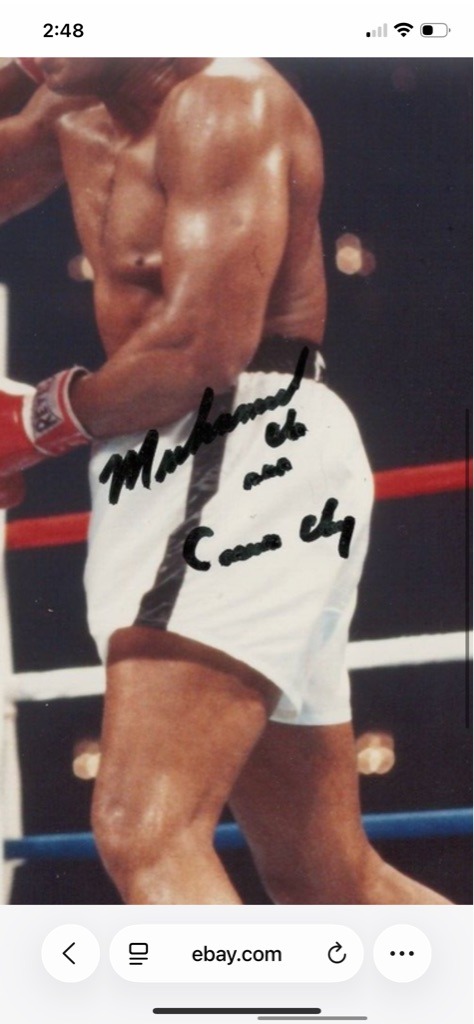
Full name 'Muhammad Ali' written above 'aka Cassius Clay'. It displays the shaky, deliberate strokes characteristic of Ali's post-Parkinson's diagnosis.
Signature Characteristics
Deliberate, slow execution. Notable shaky ascenders on the 'M' and 'A'. The 'aka Cassius Clay' is written in a stacked format which he adopted later in life to satisfy collectors.
Ink & Medium
Black felt-tip marker (Sharpie-style) on a semi-gloss photograph.
Item Description
A vertical 8x10 or similar sized color photograph of Ali in the ring, wearing white trunks with a black stripe, appearing to be from the 1970s era.
Estimated Value
$600 - $1,200 (authenticated); values fluctuate based on the specific third-party grader (PSA/JSA).
Comparison to Known Examples
Matches late 80s/early 90s exemplars where the 'C' in Clay becomes more of a hook and the 'i' in Ali is often missing a dot due to physical exertion.
Authentication Tips
Look for the natural 'tremor' versus a forged 'shake'. Forgers often hesitate, creating ink blobs; authentic Ali tremors show consistent, thin-to-thick variations in speed.
Certification Recommendation
PSA/DNA, JSA (James Spence Authentication), or Beckett Authentication Services (BAS).
Red Flags
No immediate red flags, but collectors should look for 'slow-play' where a forger tries too hard to mimic the shakiness, resulting in unnatural ink pooling.
Provenance Notes
Look for documentation from 'Online Authentics' or 'Harlan Ettinger', who were primary sources for Ali signings in his later years.
Historical Context
The signature represents a bridge between his two identities—the name he chose (Ali) and the 'slave name' (Clay) he reclaimed on paper for historical and commercial purposes later in life.
Market Trends
Ali's market remains the gold standard for boxing memorabilia. Values for dual-name signatures (Ali/Clay) have seen a 15-20% uptick over the last five years.
Investment Potential
High. As a global icon, Ali's market is international and transcends sports, making it a stable 'Blue Chip' memorabilia investment.
Similar Autographs
Joe Frazier, George Foreman, and Mike Tyson; contemporary legends and rivals of the Heavyweight peak.
Display & Preservation
Frame with UV-protective glass and acid-free matting. Marker ink is highly susceptible to sunlight fading (turning brown/yellow or disappearing).
Interesting Facts
Ali would often sign for hours at his home or at public appearances despite his illness, believing it was his duty to his fans.