Muhammad Ali
Three-time World Heavyweight Boxing Champion and Global Icon · Boxing - Heavyweight Division
The Greatest of All Time (GOAT) / International Boxing Hall of Fame
Era
Circa late 1980s to early 1990s
Item Type
Lined Index Card
Condition
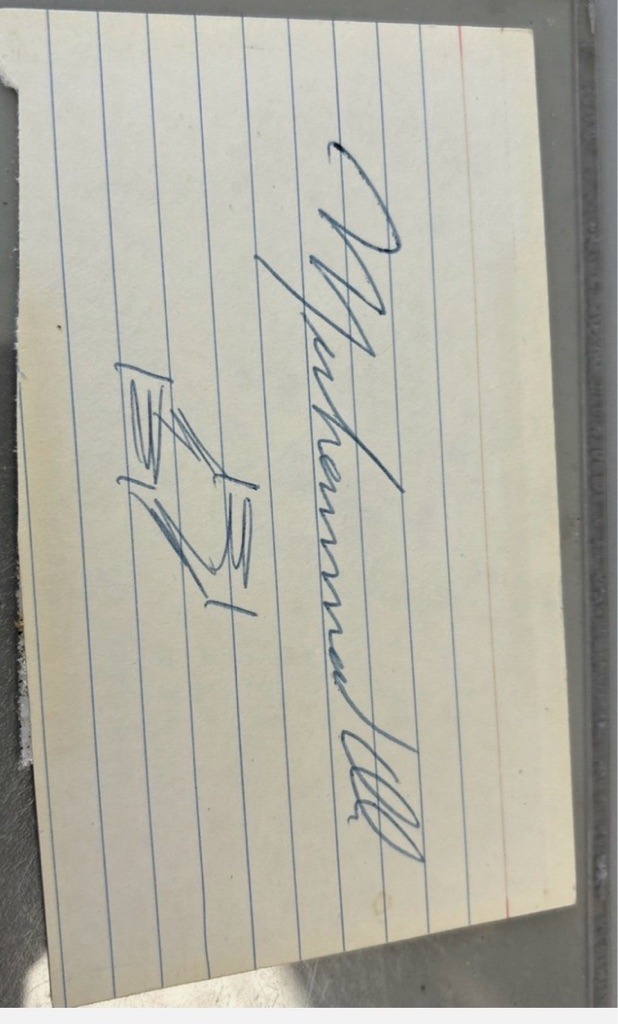
Very Good to Excellent. The signature is bold and dark with no significant fading. The card shows slight edge wear and mild toning (yellowing) consistent with age, but no major creases or stains affecting the autograph area.
Rarity
Common for Ali as a signer (he was prolific), but high demand keeps supply tight. Clean signatures on index cards are the 'gold standard' for entry-level Ali collectors.
Overall Assessment
This is a quintessential example of a Muhammad Ali autograph from his middle/retirement era. It is bold, recognizable, and on a clean medium. It represents an excellent entry point for a collector or a solid trade-up piece for an investor. Final Verdict: Highly desirable authentic-appearing specimen.
Authenticity Assessment
Likely authentic. The signature displays the natural flow and specific letter-shaping characteristics typical of Ali as his Parkinson's symptoms began to introduce slight tremors and a more condensed vertical structure, yet still maintained fluid baseline connections and his trademark loop for the 'A'. Confidence level: 85% pending physical inspection.
Signature Style
Full name 'Muhammad Ali' in cursive. It features his classic tall, sweeping 'M' and the distinctive, elongated 'i' with a separate dot or tail-off. The letters are slightly compressed, which is characteristic of his mid-to-late signing career.
Signature Characteristics
The 'M' has a sharp peak followed by rhythmic humps. The 'u' and 'h' are distinct but connected. The second 'm' in Muhammad often degrades into a wavy line in later years, which is starting to happen here. The 'A' in Ali is tall and looped, and the final 'i' often ends with a sharp vertical stroke.
Ink & Medium
Blue felt-tip marker or fiber-tip pen on a standard lined index card. The ink shows appropriate absorption into the paper fibers without excessive bleeding, consistent with period-correct writing instruments.
Item Description
A standard 3x5 or 4x6 inch white lined index card, commonly used for 'in-person' autograph collecting during the 20th century.
Estimated Value
$400 - $650 USD (Raw); $800 - $1,200+ USD (Authenticated/Encapsulated).
Comparison to Known Examples
This example aligns well with Ali exemplars from the 1988-1994 period. It is more legible than his 'ghost' signatures of the 2000s but shows more compression than his 'Cassius Clay' or early 'Muhammad Ali' 1960s vectors.
Authentication Tips
Look for the 'rhythm' of the signature. Ali's hand was fluid even when shaky. Forgeries often look too 'slow' or 'stiff.' Pay close attention to the way the 'm's transition and how the 'A' in Ali is formed – it usually has a specific counter-clockwise loop.
Certification Recommendation
PSA/DNA, JSA (James Spence Authentication), or Beckett Authentication Services (BAS). PSA/DNA encapsulation is highly recommended for index cards.
Red Flags
No significant red flags observed. The ink flow suggests a natural speed, and the shaky transitions appear organic rather than 'drawn' by a forger.
Provenance Notes
Index cards are often obtained in-person. Documentation from the original collector regarding the date and location (e.g., a hotel, airport, or signing event) would add premium value.
Historical Context
Ali is arguably the most recognized athlete in history. This signature represents a period where he was a global ambassador for peace and sportsmanship, traveling extensively despite his health challenges.
Market Trends
Ali's market remains one of the most stable in sports memorabilia. Since his passing in 2016, prices for clean, bold signatures have steadily appreciated as the 'signing supply' is now finite.
Investment Potential
Strong. As a cornerstone of any serious sports collection, a high-quality Muhammad Ali signature is a blue-chip asset that typically beats inflation and market volatility.
Similar Autographs
Collectors of Ali often seek signatures from Joe Frazier, George Foreman, or Mike Tyson to complete 'Heavyweight Legend' sets.
Display & Preservation
Should be kept in a PVC-free plastic holder or professionally framed with UV-protective glass. Avoid direct sunlight, as blue felt-tip ink is susceptible to light-induced fading over time.
Interesting Facts
Ali was known for never turning down a fan's request if he was physically able to sign. He would often sit for hours until every person in line had an autograph, frequently adding religious or peace-related inscriptions.