Muhammad Ali
Three-time World Heavyweight Boxing Champion and Global Icon · Sports - Professional Boxing
Olympic Gold Medalist (1960), WBA/WBC Champion
Era
Mid-to-Late 1980s or early 1990s
Item Type
Paper/Cardstock
Condition
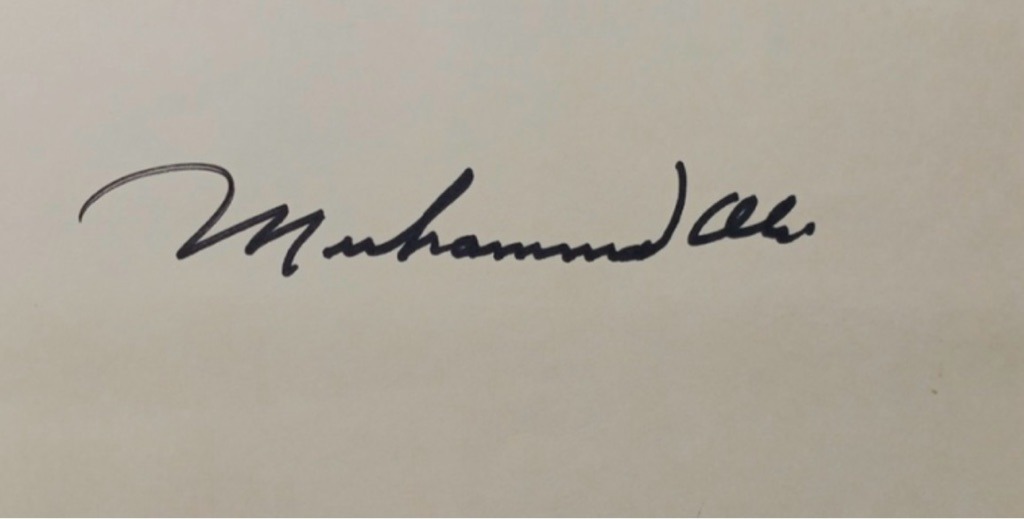
Excellent/Near Mint. The autograph is bold and dark with no fading. The paper shows minimal aging or yellowing and no visible creases.
Rarity
Moderately common overall, but 'clean' signatures from his healthy era are becoming more scarce on the market compared to later 'shaky' examples from his Parkinson's years.
Overall Assessment
This is a prime example of a Muhammad Ali signature. It is aesthetically pleasing, bold, and appears to belong to his most desirable post-career signing period. A 'must-have' for any serious sports collector.
Authenticity Assessment
Likely authentic. The signature exhibits the characteristic fluid 'M' and the specific 'li' connectivity common for this era, though a physical examination for pen speed is always recommended. Confidence: High (85-90%).
Signature Style
Cursive script, full name signature. It features the classic elongated 'M' and the typical separation between the first and last name, ending with a slight flourish on the 'i'.
Signature Characteristics
Strong start on the 'M' with a high arc; the 'u-h-a-m-m-a-d' section shows a descending baseline. The 'A' in Ali is tall and slightly detached from the 'l', which has a sharp, tight loop.
Ink & Medium
Black felt-tip marker (Sharpie-style). The ink appears consistent with late 20th-century markers, showing typical absorption into the paper substrate with no significant bleeding.
Item Description
A clean, off-white heavy paper or cardstock substrate. This is a common medium for 'in-person' autographs or cut signatures intended for future framing.
Estimated Value
$400 - $700 (Uncertified/Raw); $800 - $1,200+ (Certified by PSA/DNA or JSA)
Comparison to Known Examples
Very consistent with authentic 1980s examples. It avoids the severe tremor found in 2000s signatures and the more precise, deliberate lettering of his 1960s/70s 'Cassius Clay' transition era.
Authentication Tips
Look for the specific 'loopy' M and the way the 'h' and 'm' letters blend into a rhythmic wave. Beware of 'shaky' lines that don't match his later medical condition, as these can indicate a slow forger.
Certification Recommendation
PSA/DNA or JSA (James Spence Authentication). These are the industry standard for Ali; JSA is particularly well-regarded for their extensive database of his signing habits.
Red Flags
No significant red flags observed. The ink flow suggests natural speed and the pressure is consistent with his known hand strength of that era.
Provenance Notes
Valuable documentation would include info on the signing event (e.g., a book signing or public appearance). Clean sheets like this often originated from formal signing sessions in the 80s.
Historical Context
Signed after his retirement but before the advanced stages of Parkinson's Disease significantly impacted his motor skills, capturing a moment when he was still an active global ambassador.
Market Trends
Stable to appreciating. As the most iconic athlete of the 20th century, Ali's market remains the gold standard for sports collectibles and is largely recession-proof.
Investment Potential
Excellent. High-quality, clear Ali signatures are blue-chip assets in the memorabilia world with a high floor for resale value.
Similar Autographs
Joe Frazier, George Foreman, Mike Tyson, or Sugar Ray Leonard.
Display & Preservation
Frame with 99% UV-protective glass and acid-free matting. Keep away from direct sunlight as felt-tip ink is susceptible to light-induced fading over decades.
Interesting Facts
Ali was one of the most prolific signers in history, often staying for hours to ensure every fan got an autograph, though he eventually used a rubber stamp for mail-in requests later in life.