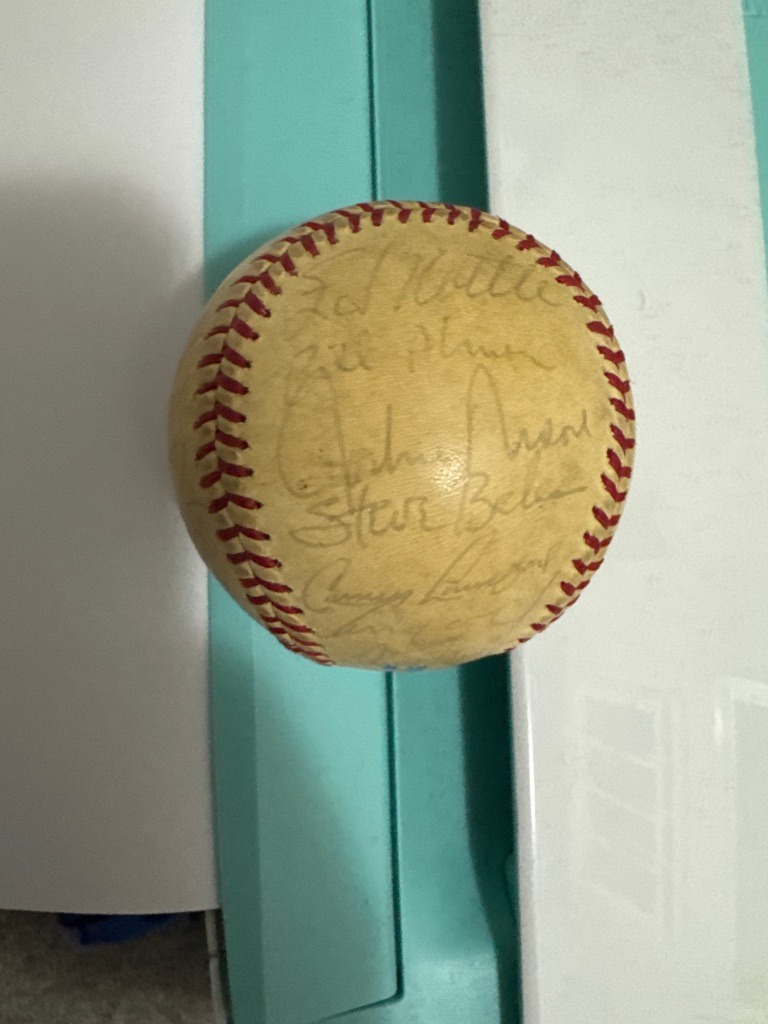
Multiple Signers (Seattle Mariners circa 1988), including Mike Moore and Steve Belcher
Professional MLB Baseball Players · Baseball - MLB
Seattle Mariners
Era
Circa 1987-1988
Item Type
Team-signed Baseball
Condition
Poor to Fair. The ball is heavily toned (yellowed) and the signatures are severely faded, making several names illegible to the naked eye. Overall grade: 2/10.
Rarity
Common. Team-signed balls from the late 80s Mariners are relatively high in supply, as they were not a championship-caliber team during this specific window.
Overall Assessment
A genuine but poorly preserved artifact of 1980s Seattle baseball. Its value is primarily local and sentimental. Rating: 3/10 for collectibility.
Authenticity Assessment
Likely authentic, though heavily faded. The natural patterns of pen pressure and script style on names like 'Steve Belcher' and 'Ed Nuttle' (manager/coach level) match period-appropriate clubhouse or spring training examples.
Signature Style
Cursive, stacked signatures typical of a team-signed souvenir ball. Signatures are mostly full-name cursive script without excessive flourishes.
Signature Characteristics
Natural cursive flow with consistent baseline alignment within each individual signature. The 'S' in Steve and 'B' in Belcher show standard loops consistent with his 1980s signing habits.
Ink & Medium
Early-generation blue ballpoint pen on a natural leather or synthetic baseball surface. Significant ink absorption and fading (toning) have occurred.
Item Description
A standard regulation-sized baseball featuring multiple signatures across a single panel. The ball shows significant yellowing (toning) and the red stitching is still vibrant.
Estimated Value
$20 - $50 USD. While team balls from this era have nostalgic value, the lack of a Hall of Fame 'anchor' signature and the heavy fading significantly limit market value.
Comparison to Known Examples
The visible signatures match the 'rushed' clubhouse/spring training style found in mid-to-late 80s Mariners examples. Mike Moore's signature (likely the one above Belcher) matches his looped 'M' era.
Authentication Tips
Check for common 'clubhouse' versions where a batboy signed for players. Authentic examples from this era show varying pen pressure between different players; identical handwriting across all names is a red flag.
Certification Recommendation
JSA (James Spence Authentication) or PSA/DNA. Given the low value, a 'QuickOpinion' or 'Basic Cert' is recommended over a full letter of authenticity.
Red Flags
Severe fading is the primary concern, which can sometimes hide the 'stop-and-start' marks of a Tracer or forger. However, the uniform fading suggests natural age-related ink degradation.
Provenance Notes
Look for any connection to the Seattle/Pacific Northwest area or spring training sites in Arizona from the late 80s. A team-signed ball often comes from a 'Fan Fest' or stadium outreach event.
Historical Context
The late 1980s Mariners were a franchise in transition, just years away from the 'Griffey Era' that saved baseball in Seattle. These players represent the building blocks of that period.
Market Trends
Stable but low. 1980s non-championship team balls are currently overlooked unless they feature a young Ken Griffey Jr. (who debuted in '89) or Randy Johnson.
Investment Potential
Low. Due to the biological/chemical degradation of the ink and the lack of top-tier superstars, this is a sentimental piece rather than a financial investment.
Similar Autographs
1980s Oakland Athletics or California Angels team balls; individual Mike Moore or Alvin Davis signed baseballs.
Display & Preservation
Keep out of direct sunlight immediately. Use a UV-protected acrylic cube. Do not attempt to 'trace over' the signatures, as this destroys all value.
Interesting Facts
The Mariners of this era were known for being very accessible signers at the old Kingdome, often signing dozens of balls for fans near the dugout before games.