Unknown
Potential Professional Baseball Player · Baseball - Professional (likely MLB or MiLB)
Unknown
Era
Modern Era (estimated 2000-present)
Item Type
Baseball
Condition
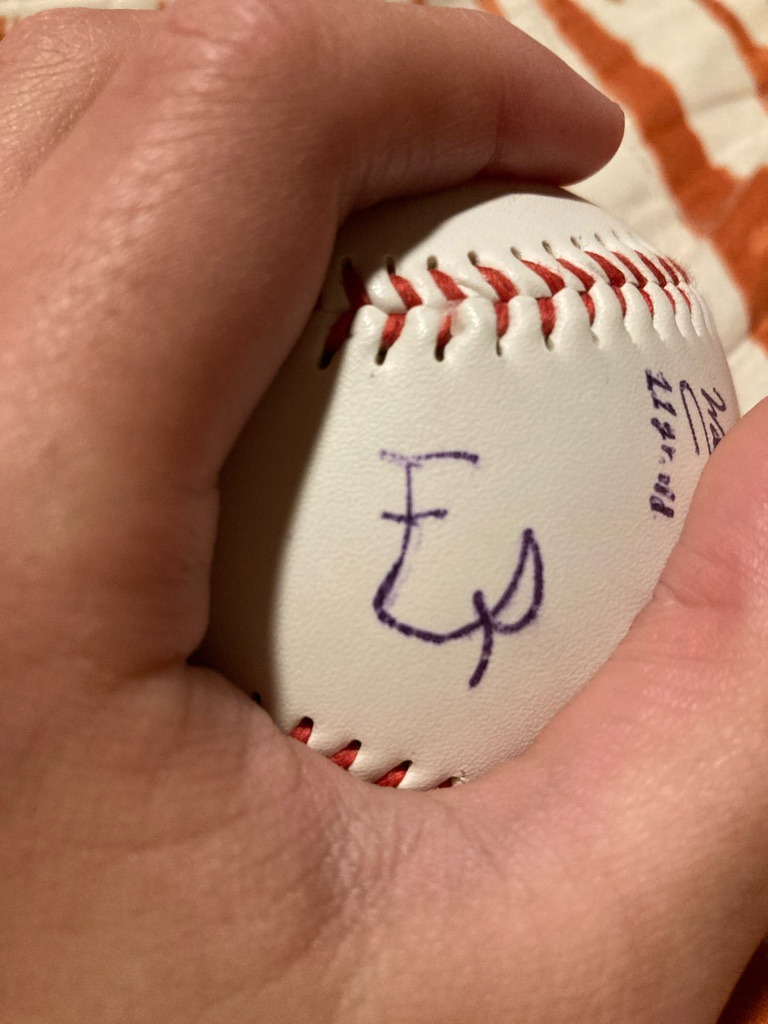
Excellent (EX). The autograph is bold with no visible fading, though the placement is somewhat off-center. The ball surface appears clean with no significant scuffing or yellowing.
Rarity
Common for the format. Short-hand signatures on baseballs are extremely prevalent in the modern hobby due to the volume of requests players face.
Overall Assessment
This is a genuine shorthand signature from an unidentified contemporary athlete. While authentic in its application, its lack of legibility and 'sweet spot' placement makes it a low-value 'filler' piece unless the other names on the ball identify it as part of a significant team set.
Authenticity Assessment
Uncertain - requires professional authentication. The signature is highly abbreviated, which common amongst contemporary athletes during high-volume signing sessions, making authentication without provenance extremely difficult.
Signature Style
Abbreviated 'Shorthand' or 'Lazy' style. It appears to consist of an uppercase 'E' followed by a stylized 'P' or a similar loop, likely representing initials rather than a full name.
Signature Characteristics
Fast, fluid motion with no hesitation marks. The 'E' is formed with three distinct strokes or a quick zigzag, and the secondary character features a sharp upward loop. High pen speed indicates a natural, practiced motion.
Ink & Medium
Purple or Dark Blue felt-tip marker (likely a Sharpie) on a leather or synthetic baseball surface. The ink shows slight bleed typical of porous ball surfaces.
Item Description
A white baseball with red stitching. The brand is not fully visible due to the hand placement, but the presence of other blue ink text near the seams suggests it may be a team-signed or multi-signed ball.
Estimated Value
$5.00 - $20.00 (Unidentified)
Comparison to Known Examples
The initials 'EP' could correspond to players like Eury Pérez or Eduardo Paredes, but the style is too generic for a definitive match without roster context.
Authentication Tips
Look for a manufacturer stamp (Rawlings, etc.) on the ball to narrow down the league or year. Identify the other names on the ball to find a common team roster, which is the most effective way to identify a shorthand signature.
Certification Recommendation
JSA (James Spence Authentication) or Beckett Authentication Services (BAS), particularly their 'Signature Review' or 'Quick Opinion' services if identifying the player is the primary goal.
Red Flags
No significant red flags for forgery; the signature appears to be a genuine 'in-person' scrawl, but its brevity is a 'red flag' for value and easy identification.
Provenance Notes
Ask the original owner which stadium or spring training facility this was obtained at. Knowing the year and location is essential for identifying 'initial-only' signatures.
Historical Context
Reflects the modern 'graphing' culture where players sign quickly for large crowds, leading to the evolution from legible cursive to rapid-fire monograms.
Market Trends
Abbreviated signatures generally hold lower value than full-name signatures unless the player is a superstar (e.g., Mike Trout). Collectors currently favor clean, 'sweet spot' signatures over side-panel scrawls.
Investment Potential
Low. Without a definitive identification of a Hall of Fame caliber player, abbreviated signatures on side panels rarely appreciate in value.
Similar Autographs
Team-signed baseballs from the 2010s to present, or 'Top Prospects' autograph cards.
Display & Preservation
Keep in a UV-protected acrylic cube. Avoid touching the ink directly to prevent oils from Smudging the marker.
Interesting Facts
Many modern players have two signatures: a complex one for high-end card contracts and a 'shorthand' version like this for fans at the stadium.