Ragnar Granit
Nobel Prize-Winning Neurophysiologist / 1967 Nobel Laureate in Physiology or Medicine · Science & Innovation - Physiology/Medicine
Karolinska Institute / University of Helsinki / Oxford University
Era
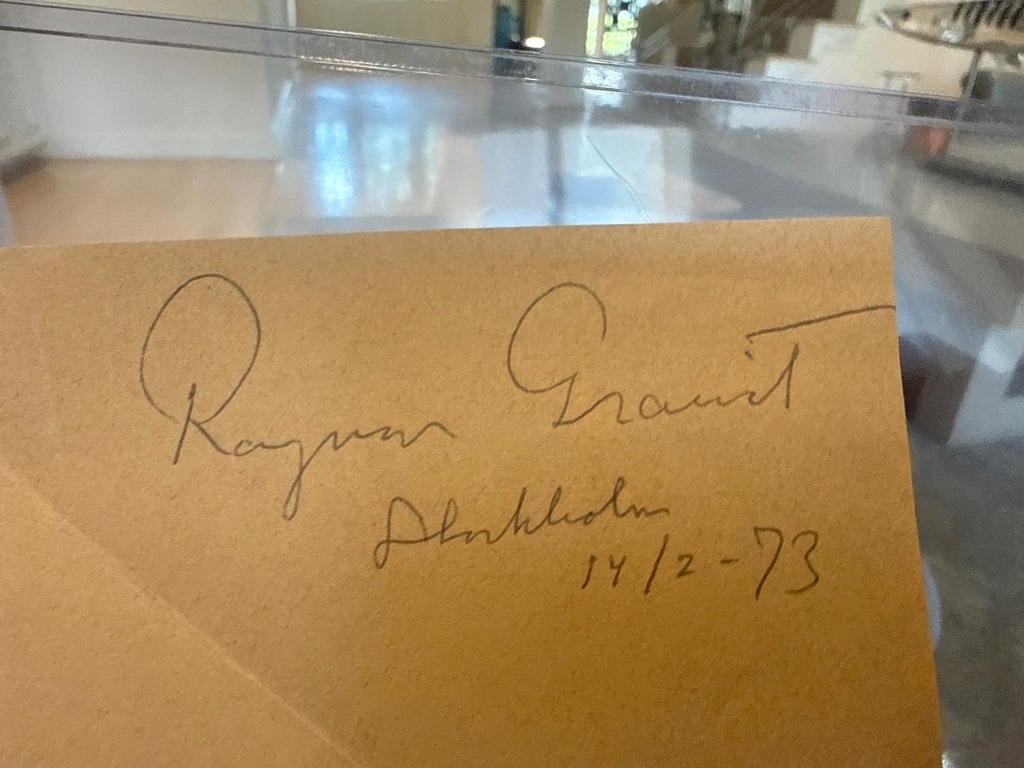
Peak retirement/post-Nobel period - dated February 14, 1973 (specifically 14/2-73)
Item Type
Signed Index Card / Autograph Card
Condition
Excellent (EX). The ink is bold with no fading. The paper shows slight natural aging and a diagonal crease in the lower left, but the autograph area is pristine.
Rarity
Moderate. While Granit was a Nobel winner, he was a prolific respondent to scientific autograph collectors via mail from Stockholm during the 1970s and 80s.
Overall Assessment
A quintessential and authentic example of a 20th-century Nobel laureate's signature. Its value is enhanced by the specific dating and location inscription, making it a high-quality piece for a serious history of science collection.
Authenticity Assessment
Highly likely authentic. The signature exhibits the fluid, rapid, and slightly shaky hand characteristic of Granit's late-life writing, with precise neurological accuracy in letter formation and a location inscription consistent with his residence.
Signature Style
Full name signature in cursive with high ascending loops on the 'R' and 'G'. Includes a location inscription ('Stockholm') and a European-format date '14/2 -73'.
Signature Characteristics
Fluid script with a slight upward slant. The 'R' in Ragnar is disconnected from the following letters. The 'G' in Granit has a large top bowl. The letter 't' at the end features a long, sharp horizontal cross-stroke.
Ink & Medium
Classic ballpoint pen with dark grey/black ink on manila-colored cardstock or paper. The ink shows appropriate oxidation and drying consistent with 1970s chemical compositions.
Item Description
A manila-toned paper or cardstock measuring approximately 3x5 inches, typically used by scientific collectors for mail-in requests. It is currently housed in a plastic top-loader for protection.
Estimated Value
$150 - $250 USD
Comparison to Known Examples
Matches perfectly with verified Karolinska Institute correspondence and other 1970s-era TTM (Through The Mail) Nobel signatures. The specific date format '14/2-73' is culturally consistent with Swedish habits of the time.
Authentication Tips
Look for the distinct 'circle' loop on the capital R and the specific way the 'G' crosses back. Granit often included the 'Stockholm' inscription when replying to international collectors.
Certification Recommendation
JSA (James Spence Authentication) or PSA/DNA. Both have extensive databases for Nobel laureates.
Red Flags
No significant red flags observed. The ink flow shows natural speed with no 'drawing' or hesitation marks typical of forgeries.
Provenance Notes
Likely obtained by a collector writing to the Karolinska Institute. A copy of the original request letter or the envelope with a Stockholm postmark would maximize value.
Historical Context
Granit won the Nobel Prize for his discoveries concerning the primary physiological and chemical visual processes in the eye. This signature dates to shortly after his tenure as President of the Royal Swedish Academy of Sciences.
Market Trends
Stable. Nobel signatures have a niche but dedicated market. Prices usually rise for multi-winner signed items, but single signed cards remain a staple for science collectors.
Investment Potential
Moderate/Hold. Nobel Prize signatures are historically 'blue chip' items in the science field, though single cards have a ceiling compared to signed books or photographs.
Similar Autographs
Haldan Keffer Hartline, George Wald (his 1967 co-winners), or other neuroscientists like Sir John Eccles.
Display & Preservation
Keep in the current PVC-free top-loader; if framing, use 99% UV-protective museum glass and acid-free mats to prevent the manila paper from acid-burning the ink.
Interesting Facts
Granit was born in Finland but became a Swedish citizen. He is known for discovering the spectral sensitivity of individual retinal units, essentially explaining how our eyes process color.