Multiple Signers (Team-Signed Baseball)
Professional Baseball Players and Coaching Staff · Baseball - MLB
Unidentified Team (Multiple signatures require rotation and individual verification)
Era
Modern Era - Circa 2010s to Present
Item Type
Multi-signed Baseball
Condition
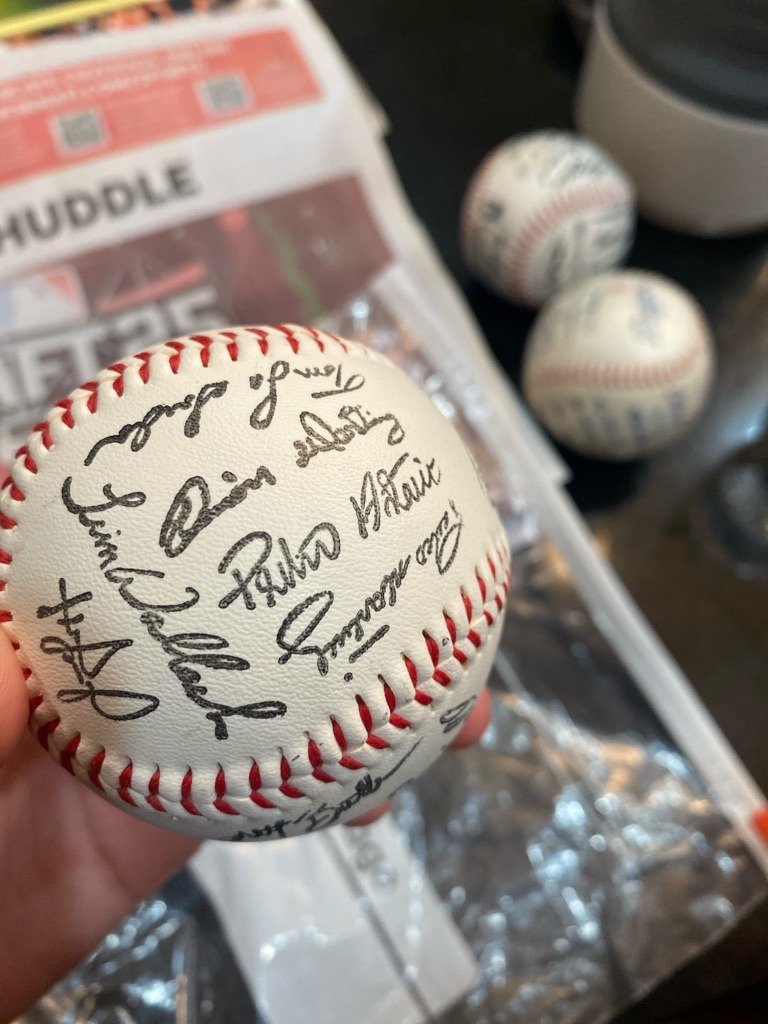
Excellent/Near Mint. The ball is bright white with no visible scuffing or yellowing. The signatures are bold with minimal fading or bleeding.
Rarity
Common. Team-signed baseballs from modern squads are frequently produced during spring training or fan events.
Overall Assessment
This is a clean, well-preserved multi-signed baseball from the modern era. While the signatures are bold, identifying the specific team and ensuring they are not clubhouse versions is the essential next step for any serious collector.
Authenticity Assessment
Uncertain - Requires professional authentication. The signatures appear to be hand-signed (not stamped), but the fluid nature suggests a clubhouse or souvenir signing environment. Confidence level: Moderate.
Signature Style
Cursive scripts of varying legibility, typical of modern professional ballplayers. Includes several vertical and horizontal placements around the ball panels.
Signature Characteristics
Natural variations in pen pressure and stroke speed suggest multiple hands were involved. Lettering like the 'P' and 'B' in the center signature show standard loops consistent with rapid signing.
Ink & Medium
Black fiber-tip or felt-tip marker (likely Sharpie) on a synthetic or leather baseball surface. The ink shows typical absorption for a 'souvenir' or 'practice' quality ball.
Item Description
A white baseball with red stitching featuring approximately 6-10 signatures visible across the sweet spot and side panels. It appears to be a retail-grade or souvenir baseball rather than an Official Major League Game Ball (ROMLB).
Estimated Value
$50.00 - $150.00 (Highly dependent on identifying a 'star' signature; as a generic team ball, value is nominal).
Comparison to Known Examples
Signatures appear consistent with rapid, in-person signing sessions rather than slow, deliberate forgeries.
Authentication Tips
Check for 'clubhouse' signatures where one person signs on behalf of others. Verify that all players signed were on the same roster during a single season.
Certification Recommendation
JSA (James Spence Authentication) or PSA/DNA for a 'Full Letter of Authenticity' if a high-value player is identified.
Red Flags
The ball lacks an official league stamp (suggesting it’s a 'knock-off' ball), which often reduces secondary market value compared to Official Major League Baseballs.
Provenance Notes
Look for documentation regarding which stadium or event this was obtained at. Presence of other similar balls in the background suggests a bulk signing or fan-pack purchase.
Historical Context
Reflects the modern fan experience of chasing autographs at the dugout or through high-end memorabilia 'breaks'.
Market Trends
The market for team-signed balls is stable but requires clear authentication of every name to reach peak value.
Investment Potential
Low potential unless a future Hall of Famer's signature is identified on a side panel. Generally viewed as a hobbyist item rather than a blue-chip investment.
Similar Autographs
Collectors of team-signed balls also look for 500 Home Run Club balls or All-Star Game signed memorabilia.
Display & Preservation
Should be kept in a UV-protected acrylic cube. Avoid direct sunlight which will cause Sharpie ink to turn brown or fade completely.
Interesting Facts
Many modern players use 'short form' signatures that look like initials to save time during long signing sessions.