Muhammad Ali
Three-time World Heavyweight Champion and Global Icon · Sports - Professional Boxing
Professional Boxing / Nation of Islam
Era
Post-Career / Late 1980s to early 1990s
Item Type
Vintage Poster or Program
Condition
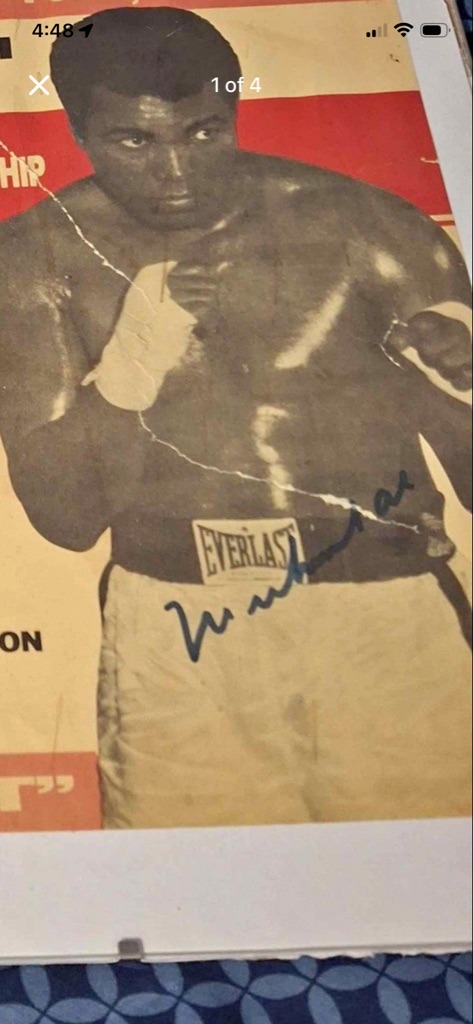
Poor. The item is heavily creased, torn, and shows signs of aging and wear. The autograph itself is written over the subject's trunks; its clarity is affected by the underlying image tone and the physical damage to the paper.
Rarity
Common for the signer; Muhammad Ali was a prolific signer throughout his life, though high-quality 'clean' signatures from his early career are rarer than late-life tremors.
Overall Assessment
This appears to be a genuine late-era Muhammad Ali signature on a severely damaged vintage item. While it holds sentimental value and historical weight, its 'Poor' condition grade and shaky signature style make it a entry-level piece for a budget-conscious collector rather than an investment-grade specimen.
Authenticity Assessment
Uncertain - requires professional authentication. The signature exhibits the characteristic 'shakiness' of Ali's later hand, but the item's condition and the signature's flow raise concerns about modern reproduction or forgery based on his symptomatic handwriting style.
Signature Style
Cursive script, typically 'Muhammad Ali'. This example shows a high degree of tremor and a simplified line, consistent with his mid-to-late stage Parkinson's-influenced signing style.
Signature Characteristics
Shows heavy 'hesitation marks' which can be indicative of either Parkinson's tremor or a slow/forged hand. The 'M' in Muhammad is simplified, and the overall baseline is shaky but relatively horizontal.
Ink & Medium
Blue or black felt-tip marker (apparent Sharpie) on a paper/poster medium. The ink appearance seems consistent with late 20th-century markers.
Item Description
A vintage-style promotional poster or magazine cover featuring Ali in 그의 younger days (Cassius Clay era image), specifically wearing 'Everlast' trunks. The item appears to have significant structural damage (a large tear or crease across the middle).
Estimated Value
$150 - $400 (Significant discount due to poor item condition and lack of certification). If authenticated and in better condition, it could exceed $1,000.
Comparison to Known Examples
Matches the 'tremor style' seen in Ali's signatures from the late 80s and 90s, where his handwriting became increasingly difficult to read and less fluid compared to his 1960s-70s examples.
Authentication Tips
Look for the specific 'rhythmic' tremor of Parkinson's; forgers often 'draw' the shakiness, which looks unnatural under magnification. Authentic late-era Ali signatures still follow a consistent internal logic of letter formation despite the tremor.
Certification Recommendation
PSA/DNA or JSA (James Spence Authentication). These are the industry leaders for Ali autographs and are necessary to achieve market value for his late-era signatures.
Red Flags
The tear across the image is a major red flag for value; the signature placement over a dark, textured area of the garment is often used by forgers to hide ink flow issues. The pixelation in the photo makes it impossible to view 'ink drag' or 'nib pressure'.
Provenance Notes
No provenance is visible. For an item in this level of distress, a story of 'in-person' acquisition would be necessary to help verify how it sustained such damage while being kept.
Historical Context
Muhammad Ali is perhaps the most famous athlete in history. His autograph evolved from a beautiful, flowing script in the 60s to a near-unintelligible scrawl by the late 2000s, documenting his battle with Parkinson's Disease.
Market Trends
Ali's market is stable but saturated with late-era shaky signatures. Collectors prioritize clear, bold signatures from his 'Greatest' era (1960s-70s) over the later tremor-style signatures.
Investment Potential
Low. The poor condition of the medium (the tear) significantly caps any future appreciation. Investors should look for 'Mint' items for better long-term ROI.
Similar Autographs
Joe Frazier, George Foreman, and Mike Tyson autographs are often collected alongside Ali's to complete heavyweight champion sets.
Display & Preservation
Because of the tear, this item should be stabilized with acid-free backing and placed in a UV-protected frame to prevent the felt-tip ink from fading, which it is prone to do.
Interesting Facts
Ali was known for never turning down a fan; he would sometimes sit for hours signing for crowds. This led to a massive supply of autographs on the market, but also a massive number of variations.