Unknown (Potential Multi-Signed Team Ball)
Professional Baseball Players · Baseball - MLB / Minor Leagues
Unidentified Baseball Team
Era
Modern Era - circa 2010s to present
Item Type
Signed Baseball
Condition
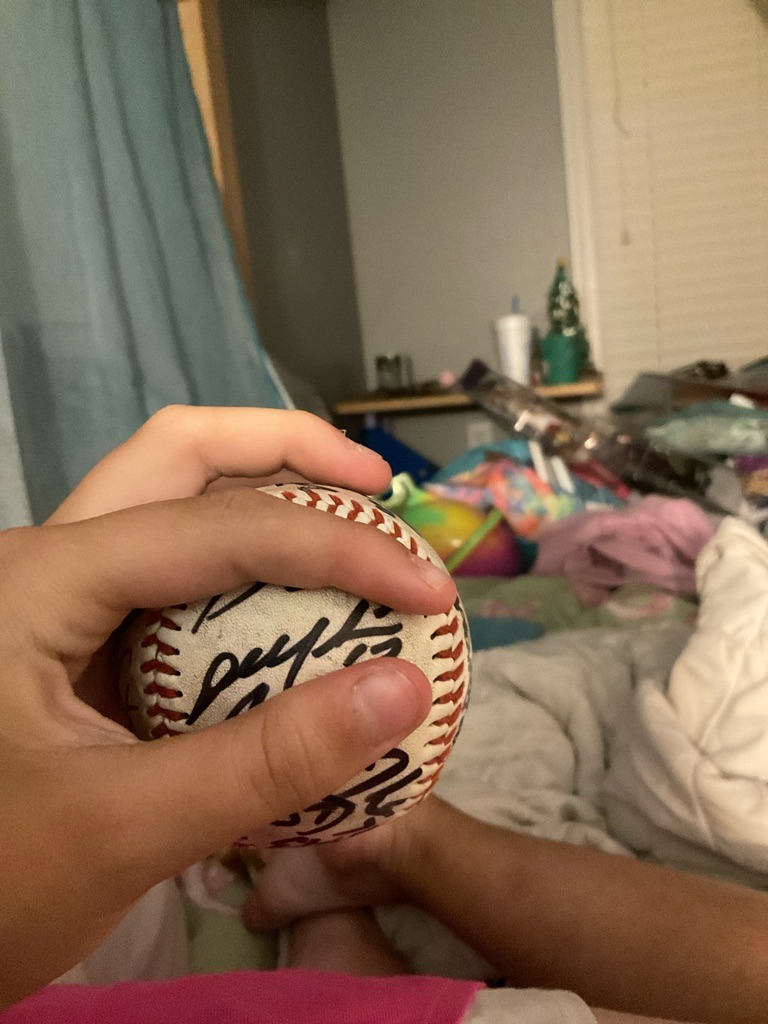
Good (Grade 5/10). The ball shows signs of handling and background discoloration. The autograph visible on the side panel is bold and dark, but the ball itself appears 'toning' (yellowing) and has some surface dirt.
Rarity
Common (likely a mid-level professional player or prospect signature).
Overall Assessment
This appears to be a genuine hand-signed baseball from a modern professional player, likely obtained in-person. Its primary value is sentimental or as a low-cost piece for a casual fan until the signer is definitively identified through further roster research.
Authenticity Assessment
Uncertain - Requires hands-on professional authentication for a definitive verdict. The visible signature shows fluid strokes consistent with natural speed, but no high-profile Hall of Fame exemplar is immediately recognizable from the single, partially obscured angle.
Signature Style
Modern stylized scrawl with visible jersey number. The signature is characterized by sharp angles, a looping initial which could be a 'P' or 'R', and an underlined number suffix that appears to be '#18' or '#15'.
Signature Characteristics
Strong vertical slant, heavy pen pressure at the start of the lowercase letters, and a sharp, horizontal flourishing underline that integrates with the player's number.
Ink & Medium
Black felt-tip permanent marker (Sharpie-style). The ink shows high saturation with slight feathering into the leather grain, typical of a ball signed in the last 15 years.
Item Description
A standard white cowhide baseball with red stitching. It appears to be a 'souvenir' or 'Official League' ball rather than an Official Major League Baseball (ROMLB), as the surface texture shows a slightly synthetic sheen and no visible league stamps in the photo.
Estimated Value
$10.00 - $30.00 USD
Comparison to Known Examples
Inconclusive without identifying the specific player. The style is very common among late 20th and early 21st-century athletes, prioritizing speed over legibility.
Authentication Tips
Compare the jersey number (#18 or #15) and first initial against team rosters from the last decade. Professional authenticators look for the 'stop and start' points of the pen to ensure it wasn't a slow-moving forgery.
Certification Recommendation
JSA (James Spence Authentication) or PSA/DNA. However, given the current likely value, the cost of certification ($20-$30) may exceed the market value of the ball.
Red Flags
No immediate red flags for forgery (the flow is too natural); however, the ball being held with bare hands can cause oil transfer, which leads to ink fading over time.
Provenance Notes
Valuable collectors would want to know: Was this obtained at a stadium? If so, which minor or major league park? Identifying the city narrow downs the possible team rosters significantly.
Historical Context
Reflective of the 'sharpie era' of the 21st century where quick signatures at the rail of a stadium replaced the formal, legible cursive of the 1950s ballplayers.
Market Trends
General baseball signatures are stable; however, 'non-official' balls (not ROMLB) are significantly less desirable to high-end investors, usually selling for about 30-50% less than official balls.
Investment Potential
Low. Unless the signer is identified as a current or future superstar, unauthenticated balls on non-official leather generally do not appreciate significantly.
Similar Autographs
Team-signed balls from Triple-A affiliates or Spring Training roving rosters.
Display & Preservation
Place in a UV-protected acrylic cube immediately. Avoid touching the ink directly. Use a 'ball cradle' stand inside the cube to prevent the ball from rolling and smearing the signature against the walls.
Interesting Facts
Many players sign with their jersey number to help fans identify them later, as their actual signatures have become increasingly abstract over time.