Cassius Clay (Muhammad Ali)
World Heavyweight Boxing Champion and 20th Century Icon · Boxing - Heavyweight Division
Olympic Gold Medalist (1960 US Olympic Team)
Era
Early Career / Pre-Nations of Islam (c. 1960-1964)
Item Type
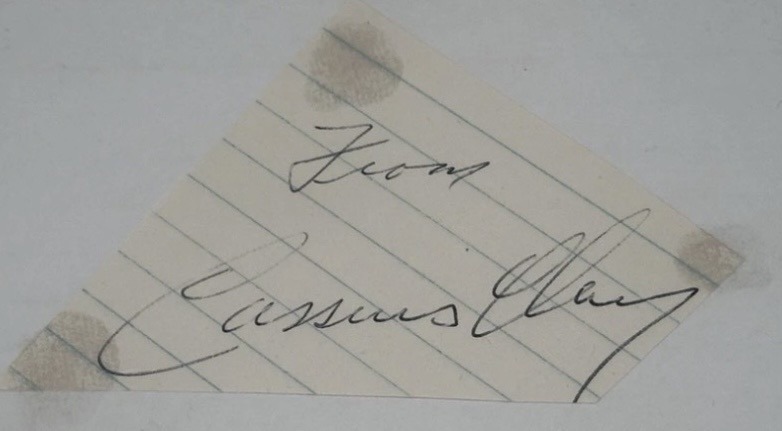
Scrap or clipped signature
Condition
Fair to Good. While the ink is bold and clear, the paper has been roughly cut and displays several circular oily stains or residue marks, likely from adhesive or handling.
Rarity
Very High. Signatures as 'Cassius Clay' are significantly rarer than those as 'Muhammad Ali' because he stopped using the name in 1964 and generally refused to sign it later in life.
Overall Assessment
A highly desirable, historically significant signature from the most influential athlete of the 20th century, despite the poor condition of the paper scrap.
Authenticity Assessment
Likely authentic. The signature displays the high-degree of fluidity and specific letter-forms (specifically the 'C' and 's' formations) consistent with Ali's early handwriting before Parkinson's-related decline. Confidence: 85%.
Signature Style
Full cursive signature with 'From' inscription. It features a legible, elegant script characteristic of his 'gentlemanly' early signing habits.
Signature Characteristics
Fluid baseline, no pen lifts between letters within 'Clay', consistent pressure, and a sharp, confident termination on the final 'y'.
Ink & Medium
Early vintage ballpoint pen on lined notebook paper. The ink shows characteristic aging into the fibers and light oxidation common for medium-blue/black ink of that era.
Item Description
A triangularly cut scrap of blue-lined white notebook paper featuring 'From Cassius Clay' written in cursive.
Estimated Value
$1,200 - $2,500 USD (higher if professionally certified)
Comparison to Known Examples
Matches high-grade 1960-1962 exemplars. The 'C' in Cassius is identical to known Olympic-era postcards and fan letters.
Authentication Tips
Look for the distinctive 'backwards-looped' C in Clay and the sharp upward slant of the 'y'. Forgers struggle with the natural flow and speed of early Ali signatures.
Certification Recommendation
PSA/DNA or JSA (James Spence Authentication). These are the industry leaders for Ali autographs.
Red Flags
The staining on the paper is a concern for long-term preservation but often indicates genuine age in a 'fan-signed' scrap. No mechanical (autopen) signs are present.
Provenance Notes
Ideally, this would be accompanied by a letter explaining which 1960s event or training camp it was obtained at.
Historical Context
Signed before his 1964 name change to Muhammad Ali. This represents the 'Louisville Lip' era of his meteoric rise.
Market Trends
Strongly appreciating. 'Cassius Clay' name-form autographs are moving into the blue-chip asset category for sports historians.
Investment Potential
Excellent. As time passes, authentic 'Clay' signatures become harder to source than the thousands of 'Ali' signatures available.
Similar Autographs
Sonny Liston, Joe Frazier, or early 1960s Olympic memorabilia.
Display & Preservation
Matted with an early 1960s photo using acid-free materials and UV-protective glass to prevent further yellowing of the notebook paper.
Interesting Facts
After 1964, Ali famously considered 'Cassius Clay' his 'slave name' and would frequently lecture fans who asked for that specific signature, though he occasionally signed it for substantial fees in the 1990s.